If you need a USB Type-C to SSD/SATA/IDE Hard Drive Reader review, this one stands out for breadth rather than polish.
It is aimed at people who need to access a mix of SATA and IDE drives without juggling multiple adapters.
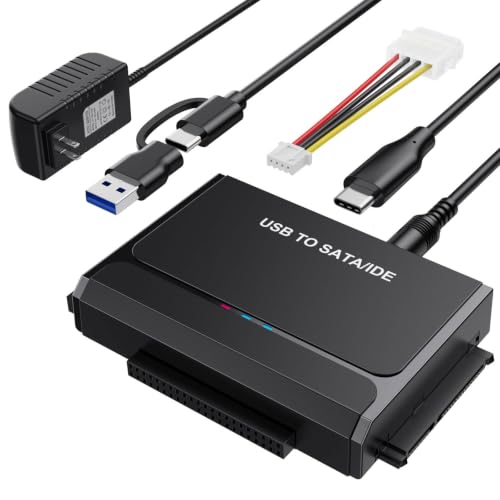
USB Type-C to SSD/SATA/IDE Hard Drive Reader Review Summary
This is a utility-first drive adapter for anyone who works with older and newer storage hardware in the same week.
The listing points to a broad compatibility set, external power for larger mechanical drives, and simple plug-and-play behavior, so it fits repair benches, home archives, and data recovery jobs better than casual everyday use.
It makes the most sense if you want one adapter that can handle 2.5-inch and 3.5-inch SATA drives, 2.5-inch and 3.5-inch IDE drives, and even optical drives.
That mix matters because it reduces the number of separate tools you need when moving files, cloning content, or checking an old drive before deciding what to do with it.
Review Scorecard
| Category | Score | Why it rates this way |
|---|---|---|
| Drive compatibility | 10/10 | Supports SATA, IDE, and optical drives, including 2.5-inch and 3.5-inch formats. |
| Recovery usefulness | 9/10 | External power and an on/off switch suit cautious drive access and backup work. |
| Transfer convenience | 8/10 | USB-C and USB-A cable support makes it easier to use across newer and older computers. |
| Legacy support | 10/10 | Dual-head IDE support and 4-pin Molex coverage make it useful for older hardware. |
| Everyday portability | 6/10 | It is a bench tool, not a tiny pocket adapter, because it depends on power and multiple cables. |
| Setup simplicity | 8/10 | The listing emphasizes driverless, plug-and-play operation on common desktop and laptop systems. |
| Value for mixed fleets | 9/10 | Strong fit if you regularly deal with varied drive types instead of one modern SSD standard. |
Key Features and Specifications of USB Type-C to SSD/SATA/IDE Hard Drive Reader
The headline feature is the 3-in-1 access design.
According to the listing, the adapter supports 2.5-inch and 3.5-inch SATA HDDs and SSDs, 2.5-inch and 3.5-inch IDE HDDs, and CD/DVD optical drives.
That is unusually broad for a single consumer adapter, and it is the main reason to consider it.
The connection side is also practical.
The package includes a 2-in-1 USB-C/A cable, so the adapter can work with both USB-C and USB-A hosts.
That makes it easier to move between modern laptops and older desktops without hunting for a separate cable.
Power handling is a major part of the design.
The listing says the unit uses a 12V/2A external power supply, which is especially important for 3.5-inch mechanical drives and legacy IDE hardware.
For smaller 2.5-inch laptop drives, the listing says USB bus power is enough.
The control details are simple but useful:
- Independent on/off switch for drive protection
- Hot-swap support
- LED activity indicator
- 4-pin Molex cable for 3.5-inch IDE drives
- Support claims for Windows 11/10/8/7, macOS, Linux, and Chrome OS
The listed speed claim is up to 5Gbps, described as SuperSpeed USB and positioned as much faster than USB 2.0.
That does not guarantee a real-world speed ceiling for every drive, but it does tell you the adapter is built for modern USB bandwidth rather than older bottlenecks.
The package contents are also straightforward: one IDE/SATA converter, one 2-in-1 USB-C/A cable, one 4-pin cable, and one 12V power supply.
For buyers, that usually means fewer surprise add-ons after purchase.
Pros and Cons of USB Type-C to SSD/SATA/IDE Hard Drive Reader
Pros
- Supports a wide mix of storage standards, including SATA and IDE
- Covers both 2.5-inch and 3.5-inch drives
- External power is a real advantage for larger mechanical drives
- USB-C and USB-A support improves compatibility with different computers
- The on/off switch is useful when you want a more controlled connection
- Optical drive support adds value for users handling older media hardware
Cons
- This is not a minimalist adapter; the power brick and cables reduce portability
- The broad compatibility is useful, but it also makes the setup feel more bench-oriented
- It is better for recovery, transfer, and troubleshooting than for a clean desk setup
- The listing focuses on function, not premium build materials or compact design
The biggest strength is obvious: one adapter can cover a lot of legacy and current storage gear.
The biggest tradeoff is equally clear: you accept a more complicated physical setup to get that coverage.
Who Should Buy USB Type-C to SSD/SATA/IDE Hard Drive Reader?
Buy this if you regularly work with drives from different eras.
It is a strong fit for technicians, IT support, home archivists, refurbishers, and anyone who needs to copy data off old desktops, laptops, or optical media without collecting several separate adapters.
It also makes sense if you expect to use 3.5-inch mechanical drives.
The external 12V/2A power supply is not an optional bonus in that scenario; it is part of what makes the adapter usable for the job.
You should also consider it if you have both USB-C and USB-A computers in your workflow.
The included cable setup reduces friction when moving between systems.
Skip it if you only use modern NVMe or a single recent SATA SSD.
In that case, a smaller, simpler enclosure or adapter will probably be easier to live with.
Skip it as well if your priority is portability above all else, because this is more of a workbench recovery tool than a travel accessory.
Drive Access and Recovery Use Cases
SATA and SSD Access
For SATA drives, the appeal is straightforward: connect, power, and read or transfer.
The listing positions the adapter as a tool for duplication, backup, and data transfer, so it is useful when you need to inspect a drive before committing to a full move.
IDE Legacy Hardware
The IDE support is what pushes this beyond a generic drive reader.
Dual-head IDE support and the included Molex power cable show that the product is aimed at older systems, not just current consumer storage.
That matters if you keep old machines around or need to recover files from retired hardware.
Controlled Power Handling
The on/off switch and external power supply are not flashy features, but they are meaningful in real use.
They make the adapter better suited to cautious connection cycles, especially when you are dealing with drives you would rather not hot-plug blindly.
Broad System Compatibility
The listing claims support across Windows, macOS, Linux, and Chrome OS.
That is useful because storage recovery often happens on whatever computer is available, not on the one you planned to use.
A broad OS claim helps the adapter serve as a general backup tool instead of a platform-specific accessory.
Alternatives to USB Type-C to SSD/SATA/IDE Hard Drive Reader
If you do not need IDE support, a simpler SATA-to-USB bridge from brands like UGREEN or Sabrent may be easier to carry and less cluttered.
For people who mainly want 2.5-inch drive access, a compact cable adapter from StarTech can be a cleaner choice.
If your goal is old-drive recovery rather than everyday transfer, look at more traditional multi-interface adapters from FIDECO or similar universal drive readers on Amazon.
For a dedicated enclosure-style workflow, a SATA SSD enclosure from ORICO may be better if you only need one drive type and want a tidier desk setup.
Is USB Type-C to SSD/SATA/IDE Hard Drive Reader Worth It?
Yes, if your actual problem is mixed-drive access.
The product earns its keep by combining SATA, IDE, USB-C, USB-A, external power, and hot-swap control in one kit.
It is not the prettiest or smallest option, and it is not the right answer for someone who only needs a modern SSD adapter.
But if you routinely deal with older drives, backup jobs, or recovery tasks, the versatility is the point.
In that context, this is a practical purchase rather than a novelty, and it looks worth buying for the right workflow.