Small bakeries need more than a basic home appliance: dependable temperature control, repeatable programs, practical loaf capacity, and easy cleanup all affect daily production. The right bread machine can simplify test batches, specialty loaves, enriched doughs, and staff training without taking over valuable workspace.
We compared 10 popular 1- to 2.2-pound breadmakers across programming, heating design, dispensers, loaf flexibility, materials, and usability. Use the guide below to narrow the list based on your menu, batch volume, and budget.
Best 10 Bread Machines for Small Bakeries Picks for 2026
Best Overall
Zojirushi Virtuoso Plus 2-Lb Breadmaker

- Dual heaters support even baking and browning
- Specialty programs include gluten-free and vegan
- Rapid cycles produce bread in about 2 hours 25 minutes
Best For: Small bakeries needing versatile 2-pound bread production
Most Customizable

- 20 automatic programs plus two custom programs
- Color touchscreen simplifies recipe and cycle selection
- Ceramic pan, dual heaters, and automatic nut dispenser
Best For: Small bakeries developing varied or customized bread recipes
Best Compact Option

- Compact 1-pound design for smaller workspaces
- Automatic dispenser handles nuts and other add-ins
- Three custom memory settings and specialty programs
Best For: Small-batch bakeries with limited counter space
Best Value Capacity

- 2.2-pound capacity for larger small-batch loaves
- 15 programs include gluten-free, dough, jam, and yogurt
- Dual heaters, ceramic pan, and automatic nut dispenser
Best For: Small bakeries seeking capacity and convenient automation
Compact Everyday Pick
Elite Gourmet 2-Lb Bread Maker

- 19 programs include gluten-free, dough, jam, and cake settings
- Three loaf sizes from 1 to 2 pounds
- 15-hour delay timer with 60-minute keep warm
Best For: Small kitchens and beginner-friendly bakery batches
Best for Everyday Use
KITCHENARM 29-in-1 Smart Bread Machine
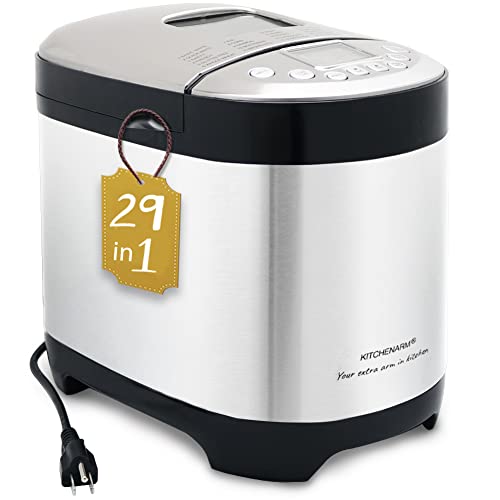
- 29 automatic menus plus a customizable HOME MADE cycle
- Four personalized menus with adjustable baking cycles
- Three loaf sizes and saved settings for repeat batches
Best For: Specialty recipes and small-bakery recipe development
Best for Consistent Crusts
Cuisinart 2-Lb Convection Bread Maker

- Convection fan supports crust color and texture
- Automatic dispenser handles fruit and nuts
- Three loaf sizes, three crust colors, and 16 programs
Best For: Small-bakery loaves with consistent crusts and mix-ins
Compact Starter
Amazon Basics Programmable Bread Maker

- 2-pound capacity with automatic mixing, rising, and baking
- 14 programs plus a less-than-90-minute ExpressBake setting
- Compact design with three crust-color options
Best For: Small operations needing simple, occasional bread production
Quiet Everyday Workhorse
2LB 17-in-1 Automatic Bread Maker

- 17 programs with three loaf sizes and three crust settings
- 15-hour delay timer and one-hour keep-warm function
- Quiet 600-watt operation with overheat protection
Best For: Flexible, scheduled baking in small bakery kitchens
Feature-Rich Production Aid

- 25 programs with dual automatic ingredient dispensers
- Convection heating and a quiet 650-watt brushless motor
- 13-hour delay timer with one-hour keep-warm function
Best For: Small bakeries prioritizing automation and specialty-bread flexibility
Best Overall – Zojirushi Virtuoso Plus 2-Lb Breadmaker
For small bakeries seeking dependable bread machines for small bakeries, the Zojirushi Virtuoso Plus combines a 2-pound capacity with dual-heater baking and specialized dietary programs. Its rapid cycles can produce white or whole-wheat bread in about two hours and 25 minutes.
Best For: Small bakeries that prioritize even browning, larger loaves, and gluten-free or specialty-diet options.
Pros:
- Dual heaters promote more even baking and browning.
- Includes whole-wheat, gluten-free, vegan, sugar-free, and salt-free settings.
- Double kneading blades thoroughly work the dough.
- Offers a 13-hour timer and rapid bread cycles.
Cons:
- At 24 pounds, it is relatively heavy for a countertop machine.
- Hand-wash care may require extra cleanup time.
With its robust 700-watt design and broad program selection, this is a strong choice when consistent 2-pound production matters more than minimizing footprint or weight.
Most Customizable – KBS Smart 2.2-Lb Bread Maker
The KBS Smart Bread Maker stands out among bread machines for small bakeries with its color touchscreen, 20 automatic programs, and two custom program slots. Its ceramic pan, dual heaters, convection system, and automatic nut dispenser support repeatable specialty-bread workflows.
Best For: Small bakeries that want extensive recipe customization, automatic add-ins, and a larger 2.2-pound capacity.
Pros:
- Two custom programs let you set knead, rise, bake, and temperature stages.
- 20 automatic programs include sourdough, gluten-free, whole-wheat, and yogurt options.
- Dual heaters and 360-degree convection promote bakery-style crust and color.
- Automatic nut dispenser, 15-hour timer, and power-failure recovery add convenience.
Cons:
- The feature-rich interface may take time to learn.
- Its 2.2-pound capacity may still be modest for higher-volume production.
This model is particularly appealing when flexibility is central to your operation, though its countertop capacity is better suited to small batches than continuous commercial output.
Best Compact Option – Zojirushi Home Bakery Maestro
For operations with limited counter space, the Zojirushi Home Bakery Maestro is one of the more compact bread machines for small bakeries. It makes 1-pound loaves and includes automatic ingredient dispensing, specialty dietary settings, and programmable homemade cycles.
Best For: Small bakeries or test kitchens producing smaller loaves and needing a space-conscious machine.
Pros:
- Compact 1-pound format weighs 16 pounds.
- Automatic dispenser adds nuts and other ingredients during the cycle.
- Includes multigrain, whole-wheat, gluten-free, vegan, sugar-free, and salt-free settings.
- Three memory settings allow customized knead, rise, and bake times.
Cons:
- Its 1-pound capacity is smaller than the other listed machines.
- It has a lower 450-watt rating and may be less suitable for larger batches.
The Maestro makes the most sense when footprint and recipe variety matter more than maximum output. Its smaller loaf size can also be useful for sampling or limited-volume specialty products.
Best Value Capacity – Neretva 2.2-Lb Bread Machine
The Neretva 2.2LB Bread Machine offers useful capacity and automation for small bakeries comparing bread machines for small bakeries. It combines 15 programs, dual-heater baking, a ceramic pan, an automatic fruit-and-nut dispenser, and a quiet motor rated below 40 dB.
Best For: Small bakeries wanting larger loaves, straightforward automation, and specialty programs at a practical scale.
Pros:
- Supports loaves up to 2.2 pounds and can serve up to six or seven people.
- 15 programs cover whole-wheat, gluten-free, sugarless, dough, jam, yogurt, and more.
- Dual heaters and 360-degree baking are designed for more even results.
- Includes an automatic dispenser, 15-hour timer, and one-hour keep-warm setting.
Cons:
- The supplied notes specify wiping the machine with a damp cloth rather than dishwasher care.
- Its 15 programs provide fewer options than the KBS model.
With a generous loaf capacity and practical automation, the Neretva is a capable choice for small-batch production, especially when quiet operation and add-in convenience are priorities.
Compact Everyday Pick – Elite Gourmet 2-Lb Bread Maker
For small bakeries that need a compact, straightforward appliance, the Elite Gourmet 2-Lb Bread Maker offers automatic kneading, rising, and baking in three loaf sizes. Its 19 presets cover everyday breads as well as gluten-free recipes, dough, jam, cake, and pizza dough.
Best For: Small kitchens, beginner-friendly bread production, and bakeries needing flexible 1-, 1.5-, or 2-pound batches.
Pros:
- 19 one-touch programs include gluten-free, wheat, rye, French, sweet, and quick bread options.
- Three loaf sizes provide flexibility for different order volumes.
- 15-hour delay timer and 60-minute keep-warm function support scheduled production.
- Compact 550-watt design helps avoid heating a full-size oven.
Cons:
- Hand-wash care may add cleanup time.
- Its 2-pound maximum may be limiting for higher-volume bakery production.
The Elite Gourmet is a practical entry-level choice when simplicity, multiple presets, and a small footprint matter more than large batch capacity or advanced recipe programming.
Best for Everyday Use – KITCHENARM 29-in-1 Smart Bread Machine
Among bread machines for small bakeries, the KITCHENARM stands out for extensive menu coverage and recipe control. It supports 29 automatic programs, three loaf sizes, and a customizable HOME MADE cycle for adjusting kneading, rising, fermentation, and baking to specific recipes.
Best For: Small bakeries developing specialty, dietary, or repeatable custom bread recipes.
Pros:
- 29 programs include whole wheat, dark rye, gluten-free, brioche, ciabatta, sourdough, keto, cake, jam, and yogurt.
- HOME MADE programming allows up to four personalized menus with adjustable cycle times and temperatures.
- Saved settings can make repeat recipes a one-press operation.
- Includes add-nuts and remove-paddle alarms, delay start, keep warm, and power-interruption recovery.
Cons:
- The extensive customization may require more setup than a basic bread maker.
- Its maximum capacity is 2 pounds, which may not suit larger production runs.
The KITCHENARM is the strongest fit for operators who want a countertop machine that can move beyond presets and consistently reproduce their own formulas.
Best for Consistent Crusts – Cuisinart 2-Lb Convection Bread Maker
The Cuisinart 2-Lb Bread Maker is a solid option for small bakeries prioritizing finished-loaf appearance and texture. Its convection fan circulates air during baking, while 16 menu programs, three crust colors, and three loaf sizes provide useful day-to-day flexibility.
Best For: Small bakeries seeking customizable crust color and automatic fruit-and-nut additions in a stainless-steel machine.
Pros:
- Convection baking is designed to improve crust color, texture, and consistency.
- Automatic fruit and nut dispenser adds ingredients at the appropriate time.
- Three loaf sizes up to 2 pounds and three crust-color choices support varied orders.
- Includes 16 menu programs and a limited three-year warranty.
Cons:
- It offers fewer programs than the KITCHENARM model.
- The 2-pound maximum may not meet the needs of higher-volume production.
- At 800 watts, it uses more power than the 550-watt alternatives in this roundup.
Choose the Cuisinart when convection performance and convenient mix-in handling are more valuable than the broadest menu selection or advanced cycle programming.
Compact Starter – Amazon Basics Programmable Bread Maker
For small bakeries exploring bread machines for small bakeries, the Amazon Basics Programmable Bread Maker offers a straightforward 2-pound format with automatic mixing, kneading, rising, and baking. Its 14 programs and ExpressBake setting provide useful flexibility when space and simplicity matter.
Best For: Small operations needing an affordable, easy-to-use machine for standard loaves, doughs, and gluten-free recipes.
Pros:
- 2-pound capacity in a relatively compact 11.6-by-9.17-by-11.6-inch design
- 14 programs include bread, dough, gluten-free options, and jam
- ExpressBake can produce bread in less than 90 minutes
- Three crust-color settings and an LCD display simplify customization
Cons:
- 550-watt power may be less suited to demanding, continuous production
- Capacity is limited to one 2-pound loaf at a time
This is a practical entry point for a small bakery that values simple controls and varied programs over higher-volume output. The compact footprint and quick-bake option are useful for limited spaces, but its single-loaf capacity is better suited to supplemental production than busy commercial schedules.
Quiet Everyday Workhorse – 2LB 17-in-1 Automatic Bread Maker
For bread machines for small bakeries that need broad menu flexibility, this 2-pound automatic bread maker combines 17 programs with three loaf sizes and three crust settings. Its 600-watt motor, delay timer, and low-noise operation make it convenient for scheduled or overnight baking.
Best For: Small bakery kitchens and beginners wanting flexible everyday baking with low-noise operation and programmable timing.
Pros:
- 17 programs cover bread, cake, whole wheat, jam, yogurt, and gluten-free recipes
- Supports 1-, 1.5-, and 2-pound loaves with light, medium, or dark crusts
- 15-hour delay timer and one-hour keep-warm function support scheduled service
- Non-stick pan, included measuring tools, hook, stirring rod, and recipe book aid setup
Cons:
- Basic 2-pound capacity may limit batch volume for higher-demand production
- Overheat protection can pause operation for approximately 20–30 minutes after extended use
- Listed basic-cycle times run roughly 3 hours 35 minutes to 3 hours 45 minutes
This model offers a useful balance of automation and customization for a small bakery producing varied loaves in modest quantities. Its timer and quiet 50-decibel operation are particularly practical, though the stated bake times and overheat pause should be considered when planning consecutive batches.
Feature-Rich Production Aid – KOVIET 25-in-1 Bread Maker
Among bread machines for small bakeries, the KOVIET 25-in-1 Bread Maker stands out for its automatic dual dispensers, convection heating, and broad program selection. The 2-pound machine supports multiple loaf sizes and specialty settings while helping automate ingredient timing.
Best For: Small bakeries wanting the most automation and recipe flexibility in a single 2-pound bread machine.
Pros:
- 25 programs include whole wheat, gluten-free, cake, jam, dough, and yogurt settings
- Dual dispensers release ingredients at the intended time using adaptive temperature control
- Convection heating and a 650-watt brushless motor support even, quiet operation
- 13-hour delay timer, one-hour keep-warm function, and power-off protection add scheduling convenience
Cons:
- 2-pound maximum capacity may not meet the needs of high-volume production
- Its 15.5-inch width and 14.6-inch height require substantial counter space
- Non-stick bread pan is specified for hand washing only
The KOVIET is the most versatile option here for a small bakery that values specialty recipes and automated add-ins. Its larger footprint and hand-wash care requirements are tradeoffs, but the dispensers, convection design, and power-loss protection make it well suited to organized, scheduled baking.
How We Picked the Best Bread Machines for Small Bakeries
We focused on features that matter in a small commercial or serious test-kitchen setting: loaf capacity, program variety, dough and gluten-free options, heating consistency, ingredient dispensers, control layout, cleanup, and overall value. Models with multiple loaf sizes or custom cycles received extra consideration because they can support recipe development and a wider menu.
These machines are best viewed as compact production and prototyping tools rather than replacements for commercial mixers, proofers, or deck ovens. Always confirm the manufacturer’s duty-cycle guidance and local food-service requirements before relying on one for daily sales.
Quick Comparison
| Best for | Prioritize | Useful features |
|---|---|---|
| Premium consistency | Durable construction and even heating | Dual heaters, programmable cycles, sturdy pan |
| Recipe testing | Control and flexibility | Custom or homemade cycles, multiple loaf sizes |
| Specialty breads | Program coverage | Gluten-free, whole wheat, dough, jam, and cake settings |
| Small budgets | Core functionality | Basic presets, delay timer, nonstick pan |
| Ingredient-heavy recipes | Hands-off operation | Automatic nut or fruit dispensers |
Key Buying Factors for Bread Machines for Small Bakeries
Capacity and Loaf Flexibility
A 2-pound machine suits many test batches and small orders, while 2.2-pound models offer slightly more room for larger formulas. Multiple loaf sizes are valuable when you sell different formats or need to scale recipes without changing equipment.
Heating and Baking Consistency
Dual-heater designs can improve browning and reduce uneven top-to-bottom baking, but results still depend on ingredient temperature, hydration, and placement. Look for a sturdy pan, reliable temperature control, and a lid window only if visibility is more useful than maximum insulation.
Programs and Manual Control
Preset menus help staff repeat standard recipes, while custom cycles are more important for bakery experimentation. Confirm that the machine includes the specific dough, gluten-free, whole-grain, cake, or bake-only functions your menu requires.
Dispensers, Cleanup, and Workflow
Automatic dispensers are useful for nuts, seeds, fruit, and mix-ins because they reduce timing errors. Removable pans and kneading paddles simplify cleanup, but check whether replacement parts are readily available. A clear touchscreen or well-labeled buttons can also reduce training time.
Who Should Buy Which Bread Machines for Small Bakeries?
Choose a premium Zojirushi model if consistency, build quality, and refined program control matter more than purchase price. Consider KBS, Neretva, or KOVIET when you want broad preset coverage, dual heating, or automated ingredient handling at a competitive price. KITCHENARM is a strong fit for recipe developers who will use custom cycles and variable loaf sizes.
For smaller budgets or occasional production, Elite Gourmet, Cuisinart, and Amazon Basics offer practical entry points with familiar automatic programs. The additional 2-pound stainless-steel models are worth considering when you want straightforward operation and a compact backup or test-batch machine. Before buying, compare warranty support, replacement-pan availability, countertop clearance, and your expected weekly run time—not just the number of advertised settings.