Choosing the best meat grinder for a sausage business means balancing throughput, grind consistency, durability, cleaning effort, and sausage-stuffing capability. The right machine should match your production volume without creating unnecessary operating or maintenance costs.
This roundup compares 10 electric grinders, including commercial #12 and #32 models, high-powered home-business options, and machines with integrated stuffing accessories. Use the guide below to narrow your choices by capacity, motor power, workflow, and budget.
Best 10 Meat Grinder for Sausage Business Picks for 2026
Commercial Workhorse
Barton #12 Electric Meat Grinder

- 1100W motor with a commercial #12 grinding head
- Includes two plates and three sausage tubes
- Removable stainless steel components simplify cleanup
Best For: Small commercial kitchens and frequent sausage preparation
Extended-Duty Pick
ARINOO Commercial #22C Meat Grinder

- Claimed output of up to 550 pounds per hour
- Designed for more than four hours of continuous operation
- Includes three stuffing tubes and a five-year warranty
Best For: Small farms and large-batch meat processing
Accessory-Rich Option
VEVOR #12 Electric Meat Grinder

- Claimed capacity of up to 552 pounds per hour
- Includes three tubes, two plates, and a kibbe kit
- Dishwasher-safe removable parts ease cleanup
Best For: Restaurants and sausage workshops needing versatility
Compact Sausage Specialist

- 750W/1HP motor grinds four to five pounds per minute
- Two speeds include a slower sausage-stuffing setting
- Reverse function and included funnel aid sausage making
Best For: Home sausage makers and smaller countertop operations
High-Volume Commercial Pick

- Up to 21 lb/min with a 1.5HP motor
- Three stuffing tubes and multiple plates included
- Cooling, overload protection, and reverse function
Best For: Restaurants, butcher shops, and small sausage operations
Versatile Home-Use Option

- Rated for 180–240 lb/hour when meat is prepared
- Five plates and three stuffing tubes included
- Also makes kubbe and burgers
Best For: Home-based sausage makers and small-batch users
Stable Commercial Alternative
VEVOR #32 Grinder With Meat Claws

- Up to 21 lb/min with a 1100W motor
- 12mm, 22mm, and 30mm stuffing tubes
- Anti-vibration feet and locking grinding head
Best For: Commercial kitchens making smaller-diameter sausages
High-Capacity Pick

- Large No. 12 grinding head and 3-pound tray
- Includes five plates, stuffing tubes, and foot pedal
- High stated throughput but household-use only
Best For: High-volume home sausage preparation
Compact Value Option

- Grinds, stuffs sausages, and makes kubbe
- Three plate sizes and two stainless blades
- Compact design with overheat protection
Best For: Home kitchens and light small-catering use
Versatile Bone-Handling Pick
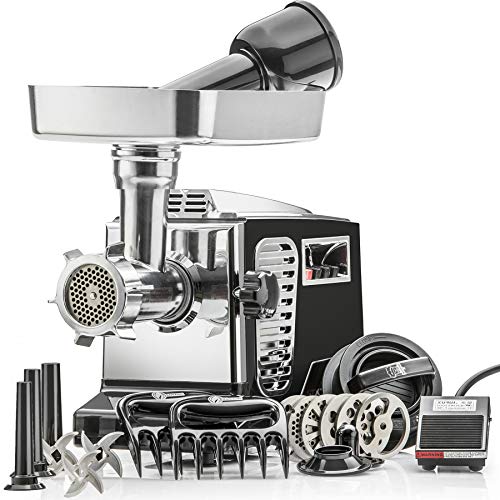
- No. 12 grinder with 3-pound high-capacity tray
- Includes six plates, three stuffing tubes, and foot pedal
- Handles specified soft bones, not all bone types
Best For: Home sausage makers wanting extra versatility
Commercial Workhorse – Barton #12 Electric Meat Grinder
For a meat grinder for sausage business operations, the Barton Commercial #12 combines an 1100W motor with a commercial-size grinding head and included stuffing tubes. Its stainless steel food-contact components and removable parts make it suited to frequent batch preparation in a home, restaurant, or small commercial kitchen.
Best For: Small commercial kitchens, restaurants, hunters, and users who want a powerful grinder with sausage-stuffing accessories.
Pros:
- 1100W motor is designed to process beef, pork, chicken, and venison efficiently.
- Commercial #12 grinding head supports consistent preparation for burgers, meatballs, and sausage fillings.
- Includes 6mm and 8mm plates plus three sausage tubes.
- Stainless steel cutting blade and food-contact components resist corrosion.
Cons:
- At 47 pounds, it is relatively heavy and less convenient to move.
- The manufacturer warranty is limited to 60 days.
The Barton is a practical choice when motor power and commercial-style capacity matter more than portability. Its included sausage accessories make it especially useful for mixed grinding and stuffing tasks.
Extended-Duty Pick – ARINOO Commercial #22C Meat Grinder
For buyers seeking a meat grinder for sausage business use, the ARINOO #22C emphasizes high-volume processing, stainless steel construction, and extended operation. Its stated output of up to 550 pounds per hour and included stuffing tubes make it a strong fit for large-batch home butchering or small-farm work.
Best For: Large-batch processing, small farms, restaurants, and users who value a long warranty and replacement-parts support.
Pros:
- Manufacturer states it can process up to 550 pounds per hour.
- Designed for continuous operation over four hours.
- 304 stainless steel construction provides corrosion and wear resistance.
- Includes two plates, two blades, and three sausage stuffing tubes.
Cons:
- Its 43-pound weight may make relocation inconvenient.
- The supplied specifications list 1100W in the features but 750W in the detailed specifications.
The #22C stands out for its claimed endurance and five-year factory warranty. Confirm the power rating and available electrical setup before purchase, especially for demanding commercial workloads.
Accessory-Rich Option – VEVOR #12 Electric Meat Grinder
The VEVOR #12 is a versatile meat grinder for sausage business prep, offering a 750W/1HP motor, a claimed 552-pound-per-hour throughput, and a broad accessory set. Three stuffing tubes, two plates, and a kibbe kit give it flexibility for sausage, burgers, meat sauce, and other preparations.
Best For: Kitchens, restaurants, butcher shops, and sausage-making workshops needing multiple accessories and easy cleanup.
Pros:
- Pure copper motor and three-stage auger support consistent grinding.
- Includes two blades, two grinding plates, three stuffing tubes, and a kibbe kit.
- Removable working components are dishwasher-safe.
- ETL approval, cooling airflow, and anti-vibration feet support stable operation.
Cons:
- Not suitable for bones or frozen meat.
- The main motor housing must not be immersed or rinsed.
- The body material is listed as aluminum rather than stainless steel.
With its useful accessory package and dishwasher-safe removable parts, the VEVOR is convenient for varied sausage and grinding tasks. It is best used with properly prepared, non-frozen meat and careful motor-housing cleanup.
Compact Sausage Specialist – Weston #12 Meat Grinder
For a meat grinder for sausage business users who want straightforward countertop operation, the Weston #12 offers a 750W/1HP motor, two speeds, and reverse. Its slower stuffing speed and included funnel make it particularly practical for making breakfast links, bratwurst, kielbasa, and similar sausages.
Best For: Home sausage makers and smaller operations that prioritize manageable size, simple controls, and dedicated stuffing functionality.
Pros:
- Grinds approximately four to five pounds per minute according to the manufacturer.
- Two speeds allow fast grinding and slower sausage stuffing.
- Reverse function helps address jams.
- Includes two stainless steel plates, a cutting blade, funnel, spacer, and stomper.
Cons:
- Its listed five-pound capacity is smaller than the high-volume capacities claimed by the other models.
- Only one sausage stuffing funnel is included.
- The one-year warranty is shorter than the ARINOO model’s stated warranty.
The Weston is a sensible choice for countertop sausage production and regular home-scale grinding. Its lighter 13.5-pound design and speed controls make it easier to handle, though larger businesses may prefer a higher-capacity machine.
High-Volume Commercial Pick – VEVOR #32 21 Lbs/Min Grinder
For a sausage business needing substantial throughput, this VEVOR #32 meat grinder for sausage business use combines a 1.5HP motor with a stated capacity of up to 21 pounds per minute. Its stainless-steel construction, sausage tubes, cooling system, and overload features make it suited to demanding preparation work.
Best For: Restaurants, butcher shops, and small sausage operations that need high-volume grinding and multiple stuffing-tube sizes.
Pros:
- Processes up to 21 pounds of meat per minute with a 1100W/1.5HP motor.
- Includes coarse, fine, and stuffing plates plus three sausage tubes from 20mm to 35mm.
- ETL listed with overload reset, reverse function, cooling system, and integrated accessory storage.
- Dishwasher-safe removable grinding and stuffing components simplify cleanup.
Cons:
- At 73 pounds, it is substantially heavier than a typical home grinder.
- The main body must be wiped rather than immersed or rinsed.
This is the strongest fit of the three for continuous, commercial-style production, particularly when capacity and durable stainless-steel construction matter more than portability.
Versatile Home-Use Option – STX Turboforce 3000 5-in-1
If you are comparing a meat grinder for sausage business startup work or lower-volume preparation, the STX Turboforce 3000 offers a broad accessory package and a stated grinding rate of 180 to 240 pounds per hour when meat is properly prepared. It is explicitly designed for home use rather than commercial production.
Best For: Home-based sausage makers and small-batch users who want grinding, stuffing, kubbe, and burger-making attachments in one unit.
Pros:
- Includes five grinding plates, three stainless-steel blades, and three sausage stuffing tubes.
- Large hopper holds approximately 3 pounds of prepared meat.
- Offers kubbe and burger/slider attachments for broader food-preparation use.
- Includes a 3-year warranty, with terms applying.
Cons:
- Not intended for commercial use.
- Must not be used to grind bones, tendons, vegetables, nuts, fruits, or plants.
- Uses a 110V power supply and is not available in 220V according to the notes.
The STX is a flexible choice for testing recipes or producing modest batches, but a growing sausage business will likely need a purpose-built commercial grinder for sustained volume.
Stable Commercial Alternative – VEVOR #32 Grinder With Meat Claws
This VEVOR #32 is another capable meat grinder for sausage business applications, delivering up to 21 pounds per minute from a 1100W motor. Compared with the other VEVOR model, it adds meat claws and anti-vibration foot pads, while offering smaller stuffing tubes for narrower sausage sizes.
Best For: Commercial kitchens and sausage makers who want high throughput, stable operation, and 12mm, 22mm, and 30mm stuffing options.
Pros:
- Stated capacity reaches 21 pounds per minute with a 1100W motor.
- Includes coarse, fine, and stuffing plates plus three smaller-diameter sausage tubes.
- Anti-vibration feet and a locking knob help keep the heavy grinder stable.
- ETL listed with cooling, overload protection, reverse-free?
Cons:
- Weighs 59.3 pounds and has a large footprint.
- The main body should only be wiped clean, not immersed or rinsed.
With its stability features and narrower tube selection, this model is a practical commercial alternative for operations making smaller-diameter sausages while still requiring fast grinding.
High-Capacity Pick – STX Turboforce HD 3500
For shoppers seeking a meat grinder for sausage business workflows, the STX Turboforce HD 3500 offers a large No. 12 grinding head, high-capacity tray, foot pedal, and multiple sausage-making accessories. Its stated output of 260 to 300 pounds per hour is substantial, but the manufacturer clearly identifies it as a heavy-duty household grinder rather than a commercial machine.
Best For: High-volume home sausage preparation and light-duty batch processing where a large accessory package is useful.
Pros:
- Large No. 12 head with a 3-pound meat tray and 2-inch feed tube.
- Includes five grinding plates, three stainless blades, three stuffing tubes, and a foot pedal.
- Stated grinding capacity of 260 to 300 pounds per hour, depending on the plate and meat.
- Includes a 3-year warranty, subject to the manufacturer’s terms.
Cons:
- Not intended for commercial use.
- Cannot grind bones, tendons, vegetables, plants, nuts, or fruits.
- Its size and 3500-watt locked motor specification may be more than occasional users need.
The extensive sausage attachments and high stated throughput make this a compelling home-production option. However, a dedicated commercial grinder may be more appropriate for a true sausage business, since this model is explicitly limited to household use.
Compact Value Option – CHEFFANO LIFE 3-in-1 Grinder
This CHEFFANO LIFE model is a practical entry point for anyone comparing a meat grinder for sausage business tasks at home or in a small catering setting. It combines grinding, sausage stuffing, and kubbe-making functions in a compact body, with three plate sizes and automatic overheat protection.
Best For: Home kitchens, BBQ gatherings, and light small-catering use that prioritize compact storage and straightforward cleanup.
Pros:
- Three-in-one design for mincing meat, filling sausages, and making kubbe.
- Includes 3mm, 5mm, and 7mm stainless grinding plates plus two blades.
- Automatic overheat protection and ETL safety certification support safer operation.
- Fully detachable components simplify cleaning and storage.
Cons:
- Designed for home and light commercial use rather than demanding production.
- Includes only one sausage tube and a smaller accessory package than the STX models.
- Parts should be hand-washed and dried promptly; they are not dishwasher-safe.
Its compact design and core sausage-making attachments suit occasional batches and small-scale preparation. Buyers needing sustained business-level production should carefully compare its 350-watt rated motor and lighter-duty positioning with larger grinders.
Versatile Bone-Handling Pick – STX Turboforce II 4000
The STX Turboforce II 4000 is a versatile choice for a meat grinder for sausage business planning when you also want the ability to process certain soft bones. Its No. 12 design, high-capacity tray, foot pedal, sausage tubes, and stated 220 to 260 pounds-per-hour output give it strong batch-processing capability for home use.
Best For: Home sausage makers who want a broad accessory set and the added flexibility of grinding specified soft bones.
Pros:
- Large No. 12 grinder with a 3-pound tray, 2-inch feed tube, and 2.5-inch output.
- Includes six grinding plates, a sausage stuffing plate, three tubes, and a foot pedal.
- Designed to handle soft chicken, rabbit, squirrel, and quail bones.
- Patented air-cooling system and circuit breaker add useful operating safeguards.
Cons:
- It is a complete home grinding package, not a stated commercial-production machine.
- Soft-bone capability does not mean it is suitable for hard bones or unrestricted bone grinding.
- The 3-year guarantee has geographic and return-condition restrictions.
This model stands out for combining sausage-focused accessories with soft-bone capability and cooling features. It can suit ambitious home batches, but commercial operators should confirm that its household-oriented warranty and design match their production requirements.
How We Picked the Best Meat Grinder for Sausage Business
We focused on the features that matter most in a small commercial or growing sausage operation: motor output, stated grinding capacity, plate and blade options, construction, sausage-stuffing accessories, controls, and ease of cleaning. We also included different grinder sizes so buyers can compare compact #12 machines with higher-capacity #22 and #32 equipment.
Advertised capacity is a useful starting point, but real-world output depends on meat temperature, cut size, fat content, feeding technique, and how often the grinder needs to pause. Stainless-steel components, removable grinding parts, and readily available replacement plates can be more valuable than a high peak-wattage number alone.
Quick Comparison
| Grinder type | Best suited to | What to prioritize |
|---|---|---|
| #12 electric grinder | Small shops, caterers, and low-to-moderate production | Reliable motor, multiple plates, compact footprint |
| #22 grinder | Regular commercial batches | Higher throughput, durable feed system, easy cleaning |
| #32 grinder | Higher-volume sausage production | Large hopper, sustained-duty performance, sturdy construction |
| Multi-function grinder | Businesses needing grinding and stuffing flexibility | Included tubes, kubbe accessories, foot pedal, and controls |
Key Buying Factors for a Meat Grinder for Sausage Business
Capacity and Production Pace
Estimate your busiest batch rather than your average workload. A #12 model can be practical for smaller operations, while a #22 or #32 grinder may reduce labor and waiting time when processing larger quantities. Leave headroom if you expect your business to grow.
Motor Performance and Duty Cycle
Compare continuous operating capability, not just maximum or marketing wattage. A grinder that maintains speed under load is generally more useful than one with a larger peak rating but frequent overheating or shutdowns. Look for overload protection and clear operating instructions.
Grinding Quality and Accessories
Multiple plate sizes let you produce coarse, medium, and fine textures. Sausage tubes should match the casings you use, and a secure stuffing setup helps prevent uneven filling. If you make several products, included blades, plates, and kubbe attachments can reduce accessory costs.
Cleaning, Safety, and Service
Choose removable food-contact parts that are simple to wash and dry. Check that the hopper, auger, knife, and plates are made from suitable materials and that replacement parts are available. Stable feet, reverse or reset functions, and accessible controls also improve daily workflow.
Who Should Buy Which Meat Grinder for Sausage Business?
Choose a #12 grinder if you run a farmers-market, catering, restaurant, or small-batch sausage business and value a smaller footprint. Choose a #22 model when production is frequent and you need a stronger balance between capacity and cost. Choose a #32 grinder for larger batches, faster processing, and a workflow built around commercial-volume preparation.
Choose a multi-function model if one machine must handle grinding, sausage stuffing, and specialty preparations. For any Meat Grinder for Sausage Business, confirm the electrical requirements, available counter or floor space, cleaning routine, warranty, and replacement-part support before ordering.