Choosing among the best meat grinders for small businesses means balancing throughput, motor performance, workspace, and long-term operating costs. A grinder that works well for occasional home use may struggle during a busy prep shift.
This roundup compares 10 electric models across different capacities and feature sets, from compact commercial-style grinders to high-powered machines with sausage and kubbe attachments. Use the guide below to narrow your options by workload, menu, and budget.
Best 10 Meat Grinders for Small Businesses Picks for 2026
Reliable Small-Batch Workhorse

- About 7 lb/min throughput
- Stainless steel, quieter design
- Five-year warranty and support
Best For: Small to medium recurring batches
High-Output Commercial Option

- Up to 552 lb/h stated capacity
- 1 HP motor with cooling system
- Dishwasher-safe removable parts
Best For: Restaurants and butcher-shop prep
Accessory-Rich Prep Grinder

- 180–240 lb/h stated output
- Five plates and multiple attachments
- Three-year warranty
Best For: Home-based or low-volume preparation
Smart-Controlled Flexible Grinder
AAOBOSI Multifunctional Grinder
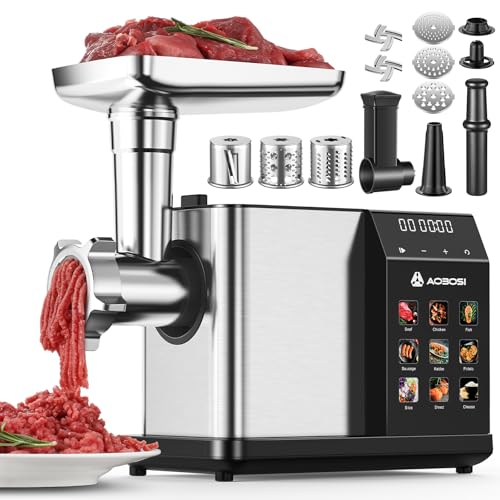
- Nine presets and nine speeds
- Up to 4 lb/min stated capacity
- Auto-reverse and built-in storage
Best For: Light-duty, home-based business prep
High-Capacity Pick
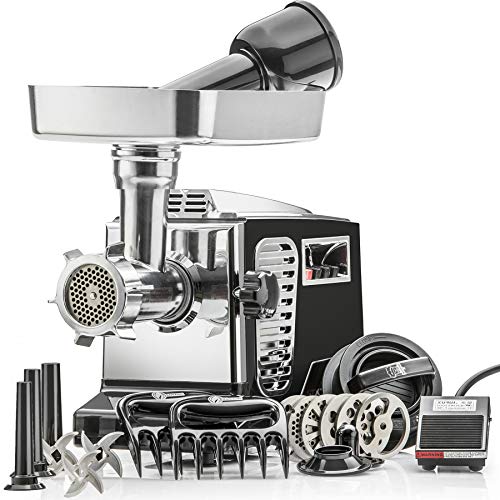
- Size No. 12 grinder with high-capacity tray
- Approximately 220–260 lb per hour
- Includes plates, sausage tubes, kubbe maker, and foot pedal
Best For: Small businesses needing higher-volume grinding and broad attachment options
Flexible Speed Pick
Sinyder 2800W Electric Grinder
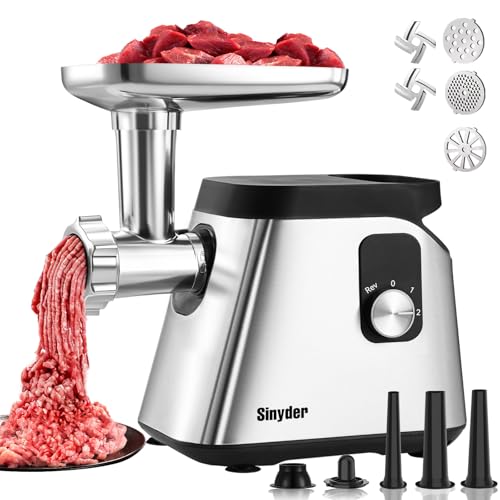
- Two speeds for grinding or sausage stuffing
- Reverse function helps clear blockages
- Includes three plates, sausage tubes, and kubbe kit
Best For: Moderate-volume operations wanting speed control and versatile attachments
Safety-Focused Value
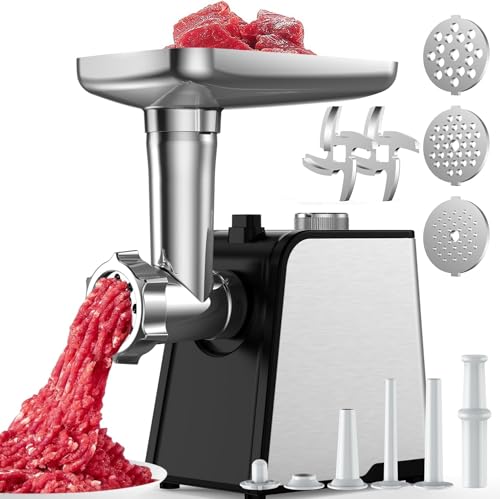
- 3200W pure copper motor
- Overload protection and thermostat system
- Includes three plates, sausage tubes, and kubbe kit
Best For: Small businesses prioritizing safety features and accessory variety
Best All-Around Pick
CHEFFANO LIFE 3-in-1 Meat Grinder

- Mincer, sausage filler, and kubbe maker
- Three grinding plates and two stainless steel blades
- Overheat protection with detachable parts
Best For: Small caterers and home-based food businesses needing versatile prep
Fast Batch Prep Pick

- 300W motor with 3200W maximum locked power
- Three grinding plates and sausage tubes
- Overload protection and reverse function
Best For: Small operations handling varied, faster batch prep
Compact Versatility Pick
CHEFFANO LIFE 2000W Max Grinder

- 500W rated motor for multiple meats
- Three plate sizes plus sausage and kubbe kits
- Compact 3-pound stated capacity
Best For: Small kitchens with modest batches and limited counter space
Reliable Small-Batch Workhorse – LEM BigBite #8
For small businesses seeking meat grinders for small businesses, the LEM Products BigBite #8 offers a practical balance of durability, quieter operation, and manageable throughput. Its 0.5 HP motor processes about 7 pounds per minute and its stainless steel construction is suited to recurring burger, sausage, game, or pet-food preparation.
Best For: Small food operations and serious home-based businesses handling small to medium batches.
Pros:
- Processes approximately 7 pounds of meat per minute.
- Stainless steel parts and noise-dampening design support repeated use with less operating noise.
- Includes three plates, a knife, stomper, and sausage-stuffing tubes.
- Five-year factory warranty, lifetime customer support, and replacement parts availability add long-term value.
Cons:
- Not designed for bones.
- Its 0.5 HP motor and stated small-to-medium-batch positioning may be limiting for high-volume commercial production.
- At 32.6 pounds, it is substantial to move or store.
The BigBite #8 is a dependable choice when consistent small-batch output, easier cleaning, and long-term support matter more than maximum commercial capacity.
High-Output Commercial Option – VEVOR #12 Meat Grinder
Among meat grinders for small businesses, the VEVOR #12 stands out for its stated capacity of up to 552 pounds per hour. Its 1 HP pure copper motor, cooling system, metal body, and included sausage and kibbe accessories make it a strong fit for operations that need faster daily prep.
Best For: Restaurants, butcher shops, and sausage-making businesses needing high stated throughput and broad accessory coverage.
Pros:
- Rated to process up to 552 pounds per hour.
- Includes two blades, two grinding plates, three stuffing tubes, and a kibbe kit.
- Removable parts are dishwasher-safe, simplifying cleanup.
- ETL approval, rapid cold-air cooling, anti-vibration feet, and a locking grinding head support secure operation.
Cons:
- Not suitable for bones or frozen meat.
- The main motor housing must not be immersed or rinsed.
- Its 36.6-pound weight may make frequent repositioning inconvenient.
With its high claimed capacity and commercial-oriented feature set, the VEVOR is the most production-focused option here, provided your workflow uses properly prepared, unfrozen meat.
Accessory-Rich Prep Grinder – STX Turboforce 3000
The STX Turboforce 3000 is one of the more accessory-heavy meat grinders for small businesses, but its supplied notes clearly position it for home use rather than commercial operation. It can process about 180 to 240 pounds per hour when meat is properly prepared and includes multiple plates, blades, stuffing tubes, and specialty attachments.
Best For: Home-based sellers or low-volume prep work that benefits from extensive sausage, kibbe, burger, and grinding accessories.
Pros:
- Includes five grinding or stuffing plates, three stainless steel blades, three stuffing tubes, and a kibbe attachment.
- Large hopper holds approximately 3 pounds of prepared meat.
- Three-speed operation and AVI auger technology provide flexible preparation control.
- Backed by a stated three-year warranty.
Cons:
- Explicitly not intended for commercial use.
- Cannot grind bones, tendons, vegetables, plants, nuts, or fruit.
- Requires properly stripped or cubed meat for its stated output.
The Turboforce offers impressive versatility for occasional or home-based production, but businesses should treat its non-commercial designation as a firm limitation when planning workload.
Smart-Controlled Flexible Grinder – AAOBOSI Multifunctional Grinder
For small businesses that value controls and recipe flexibility, the AAOBOSI combines a touch color screen, nine presets, nine speed settings, and auto-reverse operation. It delivers up to 4 pounds per minute for home use and includes grinding, sausage, kibbe, and vegetable-cutting accessories.
Best For: Home-based food businesses and prep kitchens wanting compact organization, adjustable controls, and multiple functions.
Pros:
- Smart touch screen offers nine presets and nine speed options.
- Auto-reverse is designed to help prevent clogging and jamming.
- Includes three grinding plates, two blades, sausage and kibbe attachments, and vegetable-cutting accessories.
- Built-in storage keeps accessories organized, while dishwasher-safe blades and plates simplify cleanup.
Cons:
- Continuous use should not exceed 10 minutes to help prevent overheating.
- The notes position it for home use, so it may not suit sustained commercial workloads.
- Attachments are recommended for hand-washing after use despite dishwasher-safe blades and plates.
The AAOBOSI is a versatile, user-friendly choice for lighter-duty business prep, especially where programmable controls and tidy accessory storage are priorities.
High-Capacity Pick – STX Turboforce II 4000
For small businesses that need substantial throughput, the STX International Turboforce II 4000 is one of the more capable meat grinders for small businesses in this group. Its size No. 12 design, large tray, and included foot pedal support batch-oriented prep, while the broad accessory package adds flexibility for burgers, sausages, and kubbe.
Best For: Small food businesses needing higher-volume grinding and versatile attachments.
Pros:
- Rated for approximately 220–260 pounds per hour, depending on the plate and meat.
- High-capacity tray holds over 3 pounds of meat and includes foot-pedal operation.
- Includes five grinding plates, three sausage tubes, a kubbe maker, meat claws, and patty press.
- Can handle soft bones such as chicken, rabbit, squirrel, and quail bones.
Cons:
- The extensive accessory set may be more than a lower-volume operation needs.
- The three-year guarantee is limited to the 48 contiguous states, and later warranty shipping is the buyer’s responsibility.
Choose this model when throughput and included processing tools matter more than keeping the setup simple. Its high stated capacity and size No. 12 configuration make it the strongest fit here for demanding small-business prep.
Flexible Speed Pick – Sinyder 2800W Electric Grinder
The Sinyder 2800W offers a straightforward combination of speed control, reverse operation, and sausage-making accessories. For small businesses comparing meat grinders for small businesses, its stated 3.5-pound-per-minute capacity and stainless steel construction make it a practical option for moderate prep volumes.
Best For: Small operations that want adjustable grinding speed and a compact accessory kit.
Pros:
- Pure copper motor with a stated maximum output of 2800W.
- Two speeds let users choose gentler sausage stuffing or faster grinding.
- Reverse function is designed to help clear blockages.
- Includes two blades, three plates, three sausage tubes, and a kubbe kit.
Cons:
- Detachable grinding parts require hand washing and are not dishwasher safe.
- Its listed capacity is 3.5 pounds, so it may be less suited to large continuous batches than a higher-capacity grinder.
This is a balanced choice for businesses that value control and versatility without needing the largest stated production rate. The reverse function and two-speed setup are useful conveniences for varied grinding and stuffing tasks.
Safety-Focused Value – Oaomi 3200W Electric Grinder
The Oaomi 3200W grinder emphasizes motor power, jam-clearing operation, and safety features in a relatively broad package. It is worth considering among meat grinders for small businesses when a business wants multiple plate sizes, sausage tubes, and a kubbe kit for varied menu preparation.
Best For: Small businesses seeking a powerful grinder with overload and overheating protections.
Pros:
- Pure copper motor with a stated maximum power of 3200W.
- Includes two stainless steel blades, three grinding discs, three sausage tubes, and a kubbe kit.
- Safety locks, overload protection, and a thermostat system are designed to support safer operation.
- One-touch controls and reverse function help simplify use and jam clearing.
Cons:
- The notes do not provide a pounds-per-minute or pounds-per-hour grinding capacity.
- Cleaning requirements vary: some components may be dishwasher-safe, while the feed screw and retaining ring must be washed by hand.
Oaomi is a sensible fit when protective operating features and accessory variety are priorities. Because no throughput figure is supplied, businesses should confirm expected production capacity before relying on it for sustained high-volume work.
Best All-Around Pick – CHEFFANO LIFE 3-in-1 Meat Grinder
For small businesses seeking versatile meat grinders for small businesses, this CHEFFANO LIFE model combines mincing, sausage filling, and kubbe making in one compact unit. Its three grinding plates and automatic overheat protection make it suited to household and light commercial prep.
Best For: Small caterers and home-based food businesses that need one machine for grinding, sausages, and kubbe.
Pros:
- 3-in-1 design with sausage and kubbe attachments.
- Includes 3mm, 5mm, and 7mm grinding plates for different textures.
- Automatic overheat protection and ETL safety certification.
- Detachable food-contact parts support thorough cleaning.
Cons:
- Rated at 350 watts, despite the 2800W peak claim.
- Components should be hand-washed rather than placed in a dishwasher.
This is a practical choice when product variety matters more than high-volume commercial throughput. The included accessories and stable, compact design offer useful flexibility for light-duty business preparation.
Fast Batch Prep Pick – Aiheal 3200W Max Meat Grinder
Among meat grinders for small businesses, the Aiheal stands out for its 300W motor, 3200W maximum locked power, and stated 44-pound capacity. It also includes three grinding plates and three sausage tubes for flexible batch preparation.
Best For: Small food operations that prioritize faster grinding and want multiple sausage-filling sizes.
Pros:
- 300W motor with 3200W maximum locked power for bulk batches.
- Three plates and three sausage stuffer tubes provide size flexibility.
- Overload protection automatically shuts the unit off if needed.
- Reverse button helps address clogs during grinding.
Cons:
- Recommended for home and kitchen use rather than full-scale commercial production.
- Attachments are not dishwasher-safe and need to be wiped dry.
The Aiheal offers a useful balance of speed and versatility for smaller batch workloads. Its capacity specification and accessory set make it appealing for operations preparing varied meats, sausages, burgers, or meatballs.
Compact Versatility Pick – CHEFFANO LIFE 2000W Max Grinder
This compact CHEFFANO LIFE model is a capable option for small businesses seeking meat grinders for small businesses with limited prep space. Its 500W rated motor, three plates, sausage tube, and kubbe kit cover several common preparation tasks.
Best For: Small kitchens that need a compact grinder for modest batches, sausage making, and kubbe.
Pros:
- 500W rated motor supports grinding beef, pork, poultry, venison, and fish.
- Three plate sizes—2mm, 5mm, and 7mm—allow texture adjustment.
- Includes sausage and kubbe attachments.
- Locking knob and overload protection support safer operation.
Cons:
- Listed capacity is 3 pounds, limiting larger batch work.
- Accessories should not be cleaned in a dishwasher.
With a relatively narrow footprint and a 3-pound stated capacity, this grinder is better suited to controlled, smaller production runs than continuous high-volume use. It is a sensible fit where flexibility and counter space are key considerations.
How We Picked the Best Meat Grinders for Small Businesses
We focused on the factors that matter most in a small food operation: stated motor power, grinding capacity, plate and blade options, construction materials, included attachments, controls, cleaning requirements, and practical versatility. A higher wattage number does not automatically mean better business performance, so capacity, duty cycle, feeding design, and serviceability also deserve attention.
The selected models cover a range of use cases, including burger and sausage preparation, specialty grinding, catering prep, and small-batch production. Because manufacturer specifications can vary, confirm the product listing for current capacity ratings, included accessories, warranty terms, and electrical requirements before purchasing.
Quick Comparison
| What to Compare | Best For | Why It Matters |
|---|---|---|
| Compact #8 models | Low-volume cafés and food stalls | Smaller footprint and easier storage |
| #12 grinders | Frequent batch preparation | Typically offer more capacity and faster feeding |
| High maximum-wattage models | Occasional heavy workloads | May provide extra headroom, but ratings are not directly comparable |
| Multiple plates and attachments | Menus with burgers, sausage, and kubbe | Expands preparation options without separate equipment |
Key Buying Factors for Meat Grinders for Small Businesses
Capacity and Duty Cycle
Estimate how much meat you process during your busiest shift, not an average day. A machine with a suitable feed tube and published throughput rating can reduce prep time. Also check whether the manufacturer specifies continuous operation, cooling breaks, or a recommended batch size.
Motor Performance
Look beyond peak wattage. Starting power, torque, overload protection, reverse functionality, and the ability to handle chilled meat are often more useful indicators of real-world performance. Avoid treating “maximum” wattage as a direct comparison between brands.
Plates, Blades, and Attachments
Fine, medium, and coarse plates support different recipes, while sausage tubes and kubbe kits can add value for varied menus. Stainless steel working components are generally preferable for durability and easier sanitation. Confirm which parts are removable and whether replacements are readily available.
Cleaning and Food Safety
Choose a grinder that can be disassembled quickly, has accessible food-contact surfaces, and does not rely on difficult-to-clean crevices. Follow the manufacturer’s guidance on hand washing, drying, lubrication, and sanitation; some components may not be dishwasher safe.
Workspace, Electrical Needs, and Support
Measure counter and storage space, including clearance above the hopper. Check voltage, plug type, noise, weight, and whether the unit can be secured during use. For business equipment, warranty coverage, replacement parts, and responsive support can matter as much as the initial price.
Who Should Buy Which Meat Grinders for Small Businesses?
Choose a Compact Grinder for Lighter Workloads
Small cafés, pop-ups, and vendors with limited daily volume may prefer a compact #8-style machine that is easier to move and store. It can be a sensible choice when space and budget are tighter than maximum throughput.
Choose a #12 or Higher-Capacity Model for Regular Prep
Businesses preparing several batches of burgers, sausage, or ground meat each week should prioritize a larger feed system, stronger construction, and a clearly stated throughput rating. These features can reduce repeated loading and shorten production windows.
Choose a Multi-Attachment Model for Menu Flexibility
If your menu includes sausages, kubbe, or multiple grind textures, select a package with the needed tubes, plates, and blades included. This avoids buying accessories immediately, but only if the attachments are practical to clean and replace.
Choose Durability and Support Over Peak Specifications
For daily commercial use, prioritize metal working parts, overload protection, accessible replacement components, and a warranty that matches your workload. The best meat grinder for your business is the one that safely handles your routine volume and can be maintained when something wears out.