Sharp knives improve prep speed, control, and consistency in a professional kitchen. The right sharpener should restore an edge efficiently without removing unnecessary metal or compromising the knife’s intended angle.
We compared 10 electric, manual, rolling, and precision-adjustable models to help chefs, culinary teams, and serious food professionals choose a sharpener that fits their workflow, knife types, and maintenance routine.
Best 10 Knife Sharpeners for Professional Kitchens Picks for 2026
Precision Electric Pick

- Three-stage electric sharpening system
- 100-percent diamond abrasives
- Guided 15-degree Trizor XV edge
Best For: Fast, repeatable sharpening in busy kitchens
Adjustable Manual Pick
Work Sharp Precision Adjust Elite

- 15-to-30-degree angle adjustment
- Diamond, ceramic, and serrated accessories
- Guided system for precise manual sharpening
Best For: Hands-on control across varied blade types
Dual-Angle Electric Pick

- Supports 15- and 20-degree edges
- Handles straight and serrated knives
- Diamond abrasives with polishing disks
Best For: Mixed Western and Asian-style knife collections
Compact Convenience Pick

- Guided electric sharpening needs no angle control
- Works with common and serrated kitchen knives
- Compact drawer-friendly design
Best For: Quick, simple sharpening in space-conscious kitchens
Best Rolling Sharpener

- 400-grit diamond and 3000-grit ceramic discs
- 15° and 20° magnetic angle guides
- Secure magnetic hold with replaceable discs
Best For: Chefs wanting guided manual sharpening with coarse repair and fine polishing
Best Electric System
Work Sharp MK2 Adjustable Sharpener

- Two-speed motor for control and heavier tasks
- Flexible belts handle many blade and tool types
- Includes a three-year warranty
Best For: High-volume users sharpening kitchen knives and assorted edge tools
Best for Comfort
Precision Adjust 3-Stage Sharpener
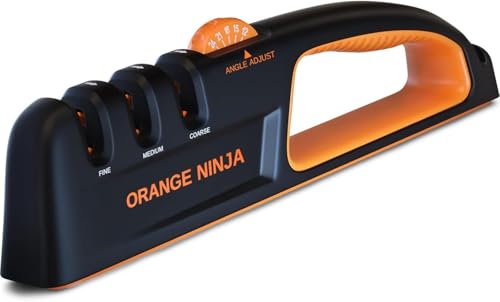
- Five angle settings from 12° to 24°
- Three coarse, medium, and fine stages
- Lightweight design for straight-edge knives
Best For: Users seeking portable angle adjustment for compatible kitchen knives
Fast Two-Stage Pick
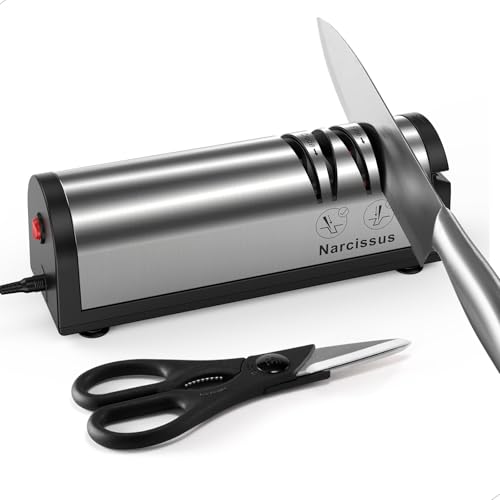
- Coarse and fine stages sharpen and polish straight blades.
- Magnetic box collects metal dust.
- Includes a scissors-sharpening slot.
Best For: Quick straight-blade maintenance and occasional scissors sharpening
Guided Budget Option

- Three stages handle repair, sharpening, and polishing.
- 15-degree guide supports consistent results.
- Non-slip base helps stabilize the unit.
Best For: Beginners maintaining everyday kitchen knives
Commercial-Ready Upgrade

- 100% diamond abrasives support fast sharpening.
- 15-degree guide promotes consistent edges.
- Magnetic collector and non-slip feet aid cleaner, stable use.
Best For: High-use home or commercial kitchens with straight-edge steel knives
Precision Electric Pick – Chef’sChoice 15XV EdgeSelect
For professional kitchens needing fast, repeatable results, the Chef’sChoice 15XV is a strong option among knife sharpeners for professional kitchens. Its three-stage system uses diamond abrasives and guided positioning to convert traditional 20-degree edges to a 15-degree Trizor XV edge on straight and serrated knives.
Best For: Busy kitchens that want an electric sharpener with automatic angle guidance and quick resharpening.
Pros:
- 100-percent diamond abrasives sharpen and hone efficiently.
- Three stages support sharpening, honing, polishing, and serrated-knife care.
- Flexible spring guides help control the sharpening angle.
- Initial sharpening takes about one minute, with resharpening in about 10 seconds.
Cons:
- It is limited to the 15-degree Trizor XV edge conversion rather than offering multiple selectable angles.
- Its countertop footprint and 4.2-pound weight may be more than occasional users need.
This is a practical choice when speed and consistency matter more than hands-on control. The 3-year limited warranty and dedicated serrated-knife polishing stage add useful support for a working knife collection.
Adjustable Manual Pick – Work Sharp Precision Adjust Elite
The Work Sharp Precision Adjust Elite suits cooks who want more control than a fully automatic machine provides. Among knife sharpeners for professional kitchens, its guided manual design stands out with adjustable angles from 15 to 30 degrees and included abrasives for kitchen, hunting, curved, and serrated blades.
Best For: Users who want precise, hands-on angle selection for different kitchen knives and blade styles.
Pros:
- Adjustable 15-to-30-degree guide accommodates Japanese-style knives, Western kitchen knives, and cleavers.
- Includes coarse and fine diamond plates plus ceramic finishing and serrated rods.
- Dedicated conical ceramic rod supports serrated knives.
- Guided clamping design helps beginners sharpen consistently.
Cons:
- Manual sharpening requires more setup and involvement than an electric sharpener.
- Its 14-inch length and 3-pound weight require dedicated storage or workspace.
This is the most versatile option of the group for someone who values angle control and a broad accessory set. It is especially useful when one sharpening system must handle multiple blade types and edge angles.
Dual-Angle Electric Pick – Chef’sChoice AngleSelect
The Chef’sChoice AngleSelect is designed for kitchens using both Western and Asian-style knives. As one of the knife sharpeners for professional kitchens, it combines diamond abrasives, precision angle control, and flexible stropping disks to support 15- and 20-degree straight-edge and serrated knives.
Best For: Professional or serious home kitchens maintaining mixed knife collections with different factory angles.
Pros:
- Supports both 15-degree Asian-style and 20-degree European or American knives.
- Works with straight, serrated, single-bevel, and double-bevel knives.
- 100-percent diamond abrasives sharpen and hone the edge.
- Flexible stropping and polishing disks help create a polished edge.
Cons:
- The supplied title describes it as two-stage while the product bullets describe a three-stage system, so buyers should verify the exact configuration.
- Its larger 12-inch by roughly 6-inch footprint may need dedicated counter space.
This model is a sensible fit when angle flexibility is more important than a compact design. Its ability to handle multiple bevel styles and serrated blades gives it broad utility for a mixed professional knife block.
Compact Convenience Pick – Work Sharp E2 Electric
The Work Sharp E2 focuses on simple, fast countertop sharpening. For buyers comparing knife sharpeners for professional kitchens, its guided electric slots accommodate chef, santoku, paring, utility, and serrated knives without requiring the user to hold a sharpening angle.
Best For: Busy kitchens and first-time users who prioritize quick, low-effort maintenance in a compact unit.
Pros:
- Guided electric sharpening requires no manual angle control.
- Designed for a broad range of common kitchen knives, including serrated blades.
- Compact design can fit in a drawer or cabinet between uses.
- Includes a power supply, double-sided abrasives, and user guide.
Cons:
- Its medium-grit abrasive specification offers less stated refinement than the diamond-focused models.
- The compact format is aimed at straightforward kitchen sharpening rather than adjustable angle work.
The E2 is the easiest choice for routine touch-ups when speed and simplicity outweigh advanced customization. Its small footprint also makes it practical for kitchens that need an accessible sharpener without a large dedicated setup.
Best Rolling Sharpener – Classic Diamond & Ceramic Kit
For professionals seeking knife sharpeners for professional kitchens without a steep learning curve, the BOGONI rolling system offers guided, repeatable sharpening. Its dual-disc setup handles edge repair and fine polishing, while magnetic angle guides reduce guesswork.
Best For: Chefs and serious cooks who want a manual sharpener with preset angles for both precision and durable everyday edges.
Pros:
- Includes a 400-grit diamond disc for reshaping and a 3000-grit ceramic disc for polishing.
- 15° and 20° magnetic guides support different edge preferences and knife types.
- Six N52 magnets help hold the knife securely during sharpening.
- Replaceable discs, a leather strop, and a natural wood design add versatility.
Cons:
- Manual rolling requires more hands-on effort than an electric system.
- The fixed 15° and 20° options may not suit knives requiring other angles.
This is a strong choice when controlled, low-noise sharpening matters. The included coarse-to-fine progression is useful for maintaining kitchen knives, while the compact kit is easy to store between service periods.
Best Electric System – Work Sharp MK2 Adjustable Sharpener
The Work Sharp MK2 is a practical option for knife sharpeners for professional kitchens when speed and repeatability are priorities. Its flexible abrasive belts conform to blade edges, and the two-speed motor adds control for heavier sharpening tasks.
Best For: Busy kitchens or users who need one powered system for kitchen knives, pocket knives, serrated blades, scissors, and larger tools.
Pros:
- Two-speed motor provides added control and power for sharpening or grinding.
- Flexible belts can work on straight, serrated, and varied edge tools.
- Edge guide supports the knife through the tip to simplify sharpening.
- Backed by a comprehensive three-year warranty.
Cons:
- Powered operation offers less of the quiet, hands-on control of a manual sharpener.
- The supplied notes identify a medium grit rather than a detailed multi-grit progression.
- Its broader tool capability may be unnecessary for kitchens sharpening only standard knives.
Choose this model if your sharpening workload extends beyond chef’s knives. The adjustable speed and flexible belts make it the most versatile option here, especially for facilities that also maintain scissors or outdoor tools.
Best for Comfort – Precision Adjust 3-Stage Sharpener
For cooks comparing knife sharpeners for professional kitchens, this compact manual system emphasizes angle control and simple operation. Five settings from 12° to 24° let users match the sharpening approach to different straight-edge knives.
Best For: Users who want a lightweight, handheld sharpener with multiple angle choices for kitchen, pocket, and hunting knives.
Pros:
- Offers five adjustable angles: 12°, 15°, 18°, 21°, and 24°.
- Three-stage coarse, medium, and fine sharpening supports repair and polishing.
- Ergonomic handheld design is intended for quick, straightforward use.
- Compact ABS construction weighs just 1.5 ounces.
Cons:
- Designed for straight-edge blades only; it is not suitable for serrated knives or scissors.
- Manual pull-through sharpening may provide less control than a guided rolling system.
- Its lightweight plastic construction may feel less substantial in demanding professional use.
This sharpener stands out for angle flexibility and portability. It makes sense for maintaining compatible straight-edge knives quickly, but teams with serrated cutlery or scissors should choose a more versatile system.
Fast Two-Stage Pick – 2-Stage Electric Sharpener
For shoppers comparing knife sharpeners for professional kitchens, this model offers a straightforward electric setup for maintaining straight-edge chef, slicing, and Santoku knives. Its two-stage design handles quick sharpening and finer polishing, while the dust collection box helps contain metal shavings.
Best For: Home cooks and small kitchen operations that want fast, simple sharpening with a scissors slot.
Pros:
- Two stages provide coarse sharpening followed by fine polishing.
- Designed for several common straight-blade kitchen knives.
- Magnetic dust collection box helps capture knife chips.
- 30-watt motor is rated for over an hour of continuous operation.
Cons:
- It is intended for straight blades and does not list serrated-knife support.
- Users should follow the instructions and watch the product video before first use.
- Its 1.6-pound weight may make it less substantial than heavier commercial equipment.
This is a practical choice when convenience and quick touch-ups matter more than extensive sharpening customization. The included scissors slot and 12-month replacement or refund policy add versatility and support.
Guided Budget Option – 3-Stage Kitchen Sharpener
Among knife sharpeners for professional kitchens, this compact three-stage electric model emphasizes repeatable results for everyday kitchen knives. Its coarse, medium, and fine diamond grinding stages are paired with a built-in 15-degree guide and a non-slip base.
Best For: Beginners and home kitchens that prioritize guided, routine sharpening of chef, utility, and paring knives.
Pros:
- Three stages support repair, sharpening, and polishing.
- Built-in 15-degree guide helps maintain a consistent angle.
- Non-slip base supports stable operation.
- Designed specifically for common kitchen knives.
Cons:
- The product is described for kitchen knives only, limiting broader tool use.
- Its supplied details do not mention a dust collection system.
- The very light 3.68-ounce listed weight may provide less countertop heft.
This model suits users who want an uncomplicated, angle-guided sharpening routine. It is best viewed as a kitchen-focused maintenance tool rather than a multipurpose sharpener for scissors or other blades.
Commercial-Ready Upgrade – 3-Stage Diamond Sharpener
For demanding kitchens, this three-stage electric sharpener combines 100% diamond abrasives with a 15-degree precision guide for straight-edge steel knives. It is built for fast touch-ups, stable countertop use, and cleaner operation with a magnetic dust collector.
Best For: Home or commercial kitchens needing fast, repeatable sharpening for chef, Santoku, utility, slicing, boning, and paring knives.
Pros:
- Coarse, fine, and polishing stages cover dull-edge restoration through finishing.
- 15-degree guide helps reduce angle guesswork and uneven wear.
- Diamond wheels can restore blades in as little as 30 seconds, according to the supplied notes.
- 120-watt overheat-resistant motor, non-slip feet, and magnetic dust collector support steady use.
Cons:
- Not designed for serrated blades or scissors.
- Its larger 10.6-inch listed length may require dedicated storage space.
- It may offer more capability than needed for occasional home sharpening.
This is the strongest fit of the three for high-use environments where speed, angle consistency, and cleanup matter. The 24-month warranty and broad straight-knife compatibility further support its role as a kitchen maintenance upgrade.
How We Picked the Best Knife Sharpeners for Professional Kitchens
We focused on the factors that matter during frequent kitchen use: sharpening speed, angle consistency, abrasive quality, edge control, ease of cleaning, and compatibility with common chef’s knives. We also considered whether each design can handle straight-edge, serrated, or specialty blades and whether it suits quick daily touch-ups or more involved edge repairs.
Electric models are useful when several knives need attention quickly, while guided manual and rolling systems offer more control and quieter operation. Products with diamond abrasives can remove material efficiently, but they should be used carefully to avoid excessive wear.
Quick Comparison
- Fastest routine maintenance: Electric sharpeners with multi-stage systems are convenient for busy prep stations.
- Most control: Precision-adjustable systems let you set the sharpening angle and progression more deliberately.
- Quietest option: Rolling and manual sharpeners avoid motor noise and are easy to use away from a dedicated workstation.
- Best versatility: Look for models that support straight-edge and serrated knives, plus scissors or other tools if needed.
- Best for consistent results: Angle guides and staged sharpening reduce guesswork for multiple users.
Key Buying Factors for Knife Sharpeners for Professional Kitchens
Angle Control
Most Western kitchen knives are sharpened around 15 to 20 degrees per side, but the correct setting depends on the blade. A fixed-angle electric sharpener is simple and repeatable; an adjustable system is better when your kitchen uses varied knife profiles or Japanese-style edges.
Abrasive and Sharpening Stages
Diamond abrasives work well for reshaping and restoring dull edges, while ceramic stages are generally better for honing and polishing. Three-stage systems typically combine repair, sharpening, and finishing, but they may remove more metal than a light honing tool.
Knife Compatibility and Safety
Check whether the sharpener accepts thick blades, narrow blades, serrated edges, or specialty knives. A stable base, clear guides, controlled passes, and minimal exposed abrasive are especially important in a commercial environment.
Speed, Maintenance, and Noise
Choose an electric model when throughput matters, but consider motor noise, dust collection, and cleaning requirements. Manual and rolling options take longer but can be easier to store and maintain.
Who Should Buy Which Knife Sharpeners for Professional Kitchens?
Busy restaurant kitchens: Choose a dependable multi-stage electric sharpener for quick, repeatable maintenance across a team’s everyday knives.
Chefs who use varied blade angles: An adjustable precision sharpener provides better control than a fixed-angle system.
Small kitchens and culinary students: A compact electric or rolling sharpener offers straightforward maintenance without requiring extensive technique.
Knife enthusiasts and edge-control specialists: Select a guided manual system that allows slower, more deliberate sharpening and repeatable angle changes.
Whichever style you choose, clean the blade first, follow the manufacturer’s pass limits, and finish with light honing rather than repeatedly using the coarsest stage. That approach helps preserve valuable kitchen knives while keeping their edges ready for service.