The best electric food mills make quick work of turning cooked tomatoes, apples, and other soft foods into smooth sauces and purées while separating skins, seeds, and fibers. They can save substantial time during canning season or large-batch meal prep.
This roundup compares 10 options across countertop food mills, electric tomato strainers, and higher-capacity milling machines. Use the guide below to match power, capacity, cleanup, and convenience to the way you cook.
Best 10 Electric Food Mills Picks for 2026
Best Electric Tomato Strainer
Weston Deluxe Electric Tomato Strainer

- 250-watt motor with forward and reverse speeds
- One-gallon hopper for batch processing
- Three screens for sauces, purees, and salsa
Best For: Large-batch preserving and garden harvests
Best Manual Food Mill
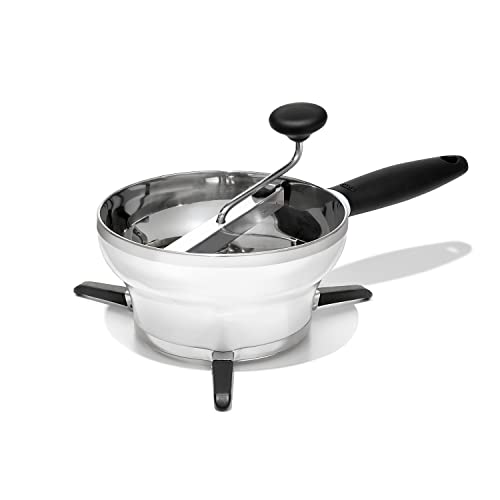
- Three discs for fine, medium, and coarse textures
- Non-slip legs fit bowls and pots up to 11 inches
- Foldable legs support compact storage
Best For: Small-batch purees and sauces
Best High-Capacity Electric Food Mill
VEVOR Electric Tomato Strainer

- Steady motor designed for continuous sauce making
- Four screens for sauces, jams, purees, and salsa
- Stainless steel parts and splatter-reducing guard
Best For: High-volume processing and canning
Best Large Manual Food Mill

- Six-quart capacity for larger puree batches
- Three stainless steel discs from 2mm to 4mm
- 18/10 stainless steel bowl with non-slip handles
Best For: Large manual batches of fruit and vegetable purees
Commercial Sauce Powerhouse
VBENLEM Electric Tomato Strainer

- 370W copper motor for high-volume processing
- 304 stainless-steel food-contact components
- Large funnel with adjustable, splash-reducing trough
Best For: Large batches of tomato sauce, ketchup, and fruit jams
Hand-Crank Versatility
Hungry Artisan 3-Disc Food Mill
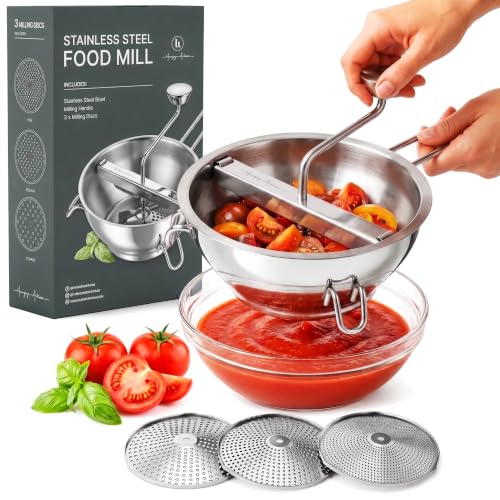
- Three discs create coarse, medium, or fine textures
- No outlet needed for portable food preparation
- Stainless-steel construction for repeated use
Best For: Small-batch applesauce, sauces, purees, and canning
High-Output Electric Choice
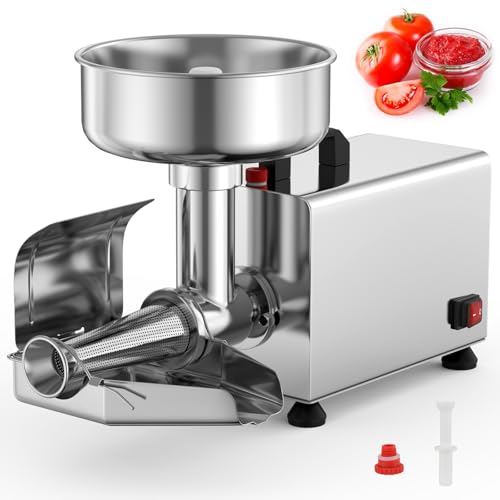
- 450W motor with stated 200–350 lbs/h capacity
- 304 stainless-steel food-contact construction
- Safety pusher and tool-free detachable components
Best For: Large batches of tomato sauce and fruit preserves
Best All-in-One Pick
AIRMSEN Electric Food Mill & Meat Grinder

- Processes tomatoes, meat, sausage, and kibbeh
- Three grinding plates offer texture control
- Reverse function and detachable parts aid usability
Best For: Home cooks seeking one multifunctional appliance
Best for Bulk Tomato Processing
VEVOR Electric Tomato Strainer

- Separates tomato skins and seeds in one pass
- Processes up to 200 pounds per hour
- Large hopper and tool-free disassembly improve batch work
Best For: Harvest-season sauce making and canning
Best High-Capacity Stainless Steel Pick

- 450W motor and 9-inch hopper suit large batches
- 304 stainless steel food-contact parts resist corrosion
- Processes tomatoes and berries for sauces or jams
Best For: Frequent high-volume sauce and jam making
Best Electric Tomato Strainer – Weston Deluxe Electric Tomato Strainer
Among electric food mills, the Weston Deluxe stands out for garden harvests and batch preserving. Its 250-watt, two-speed motor removes skins and seeds from soft fruits and vegetables, while the reverse setting helps reduce jams.
Best For: Large batches of tomato sauce, purees, jellies, salsa, and other preserved foods.
Pros:
- One-gallon hopper supports larger processing jobs.
- Includes 1.5mm, 3mm, and 6mm stainless steel screens.
- Stomper helps safely feed food into the hopper.
- Forward and reverse motor speeds improve processing flexibility.
Cons:
- Designed for electric use with a 120-volt AC power source.
- Its 14-by-12-by-17-inch size may require dedicated storage space.
The Weston is a practical choice when speed and capacity matter more than compact storage. The multiple screens also make it more versatile than a single-purpose tomato strainer.
Best Manual Food Mill – OXO Stainless Steel Food Mill
Although it is manual rather than powered, the OXO Good Grips is a useful alternative to electric food mills for cooks who want controlled, small-batch pureeing. Its stainless steel bowl handles hot foods, and three grinding discs provide fine, medium, and coarse textures.
Best For: Homemade purees and sauces prepared over bowls or pots up to 11 inches in diameter.
Pros:
- Includes three stainless steel discs for different textures.
- Non-slip legs help secure the mill over a bowl or pot.
- Spring-loaded lever simplifies disc changes and disassembly.
- Legs fold for easier storage.
Cons:
- Manual operation requires more effort than an electric model.
- The approximately 2.3-quart capacity is smaller than the large electric options here.
The OXO is a sensible pick when quiet, hands-on control and easy storage are priorities. It is less suited to processing very large harvests quickly.
Best High-Capacity Electric Food Mill – VEVOR Electric Tomato Strainer
The VEVOR electric tomato strainer is built for continuous processing, making it one of the more production-focused electric food mills in this roundup. Its motor delivers steady, high-torque operation, while the stainless steel screen separates peels and seeds in a single pass.
Best For: High-volume sauce making, tomato processing, and harvest-season canning.
Pros:
- Rated processing capacity is listed at up to 88 pounds per hour.
- Includes 1mm, 1.5mm, 3mm, and 6mm screens for varied textures.
- 304 stainless steel parts resist fruit acids and wear.
- Guard cover helps reduce splatter during operation.
Cons:
- At 7.2 pounds, it is less lightweight than a simple manual mill.
- The supplied notes describe it primarily for straining and mincing rather than general-purpose milling.
Choose the VEVOR when throughput and screen flexibility are more important than a compact countertop footprint. Its removable components and included cleaning brush should also make cleanup more manageable.
Best Large Manual Food Mill – Cuisipro Deluxe Food Mill
The Cuisipro Deluxe is a large manual option for shoppers comparing electric food mills with traditional hand-operated designs. Its extra-large 18/10 stainless steel bowl and three interchangeable discs make it well suited to preparing different puree textures without relying on a motor.
Best For: Larger manual batches of fruit and vegetable purees.
Pros:
- Large six-quart capacity supports substantial batches.
- Includes 2mm, 3mm, and 4mm interchangeable discs.
- Non-slip handles help stabilize the bowl during use.
- Underside scraper helps push puree into the bowl or pot below.
Cons:
- Manual operation is slower and more labor-intensive than electric milling.
- Its listed 17-by-9-by-10-inch dimensions may make storage challenging.
The Cuisipro is a strong fit for cooks who want generous capacity and durable stainless steel construction but prefer a manual process. Its disc range provides useful texture control for purees.
Commercial Sauce Powerhouse – VBENLEM Electric Tomato Strainer
For large batches, the VBENLEM is an electric food mill built around a 370W copper motor and stainless-steel food-contact components. Its 9-inch funnel, adjustable trough, and stated 90–160 kg/h processing range make it suited to turning tomatoes and soft fruit into sauces, ketchup, and jams.
Best For: High-volume sauce and jam making, especially for users who want a commercial-style electric machine.
Pros:
- 304 stainless-steel food-contact parts are durable and easy to disassemble.
- 370W motor and large 9-inch funnel support substantial batch processing.
- Adjustable trough and brace help direct sauce and reduce splashing.
- Designed for relatively quiet operation and easier cleaning.
Cons:
- At 22 pounds, it is substantially heavier than a hand-crank food mill.
- Its 110V electric design requires access to an outlet.
- The machine is more specialized for sauces and fruit processing than general-purpose mashing.
The VBENLEM makes the most sense when throughput matters more than portability. It is a capable electric food mill option for frequent canning or sauce production, though occasional cooks may find its commercial format more machine than they need.
Hand-Crank Versatility – Hungry Artisan 3-Disc Food Mill
The Hungry Artisan is a compact, manual alternative to electric food mills. Its hand crank and three stainless-steel discs let you choose coarse, medium, or fine textures for applesauce, tomato sauce, mashed potatoes, baby food, purees, and jam bases—without needing an outlet.
Best For: Home cooks who value portability, adjustable textures, and straightforward small-batch food preparation.
Pros:
- Three discs provide coarse, medium, and fine results.
- Requires no electricity, so it can be used anywhere.
- Stainless-steel body, discs, and crank are designed for repeated use.
- Works with applesauce, tomato sauce, potatoes, baby food, purees, and jam bases.
Cons:
- Manual cranking requires more physical effort than an electric model.
- Its 2.8-pound size and hand-crank design are better suited to smaller batches than commercial processing.
- It does not offer the powered throughput of dedicated electric tomato strainers.
This is the most flexible and portable choice in the group. Choose it if you prefer hands-on control and multiple textures; choose an electric food mill instead if speed and high-volume processing are your priorities.
High-Output Electric Choice – COSTWAY 450W Tomato Strainer
The COSTWAY is a high-output electric food mill for cooks processing substantial quantities of tomatoes and fruit. Its 450W full-copper motor, 8.5-inch feed chute, and stated 200–350 lbs/h capacity are paired with a safety pusher, enclosed motor guard, anti-slip feet, and an adjustable collection trough.
Best For: High-volume home preserving or commercial-style preparation of tomato sauces and fruit jams.
Pros:
- 450W motor and large feed chute are designed for efficient batch processing.
- Food-grade 304 stainless steel supports durability and food-contact use.
- Tool-free disassembly and dishwasher-safe detachable parts simplify cleanup.
- Safety features include a motor guard, anti-slip feet, insulated switch, and included pusher.
Cons:
- Its 22-pound weight and large footprint reduce portability.
- It operates on 110–120V power, so it needs a suitable outlet.
- The listed product-care instructions specify hand washing, despite the notes describing dishwasher-safe detachable parts.
Among these electric food mills, the COSTWAY emphasizes throughput and operator convenience. Its safety-oriented construction and removable components are useful for frequent preserving, while its size and power requirements make it less attractive for occasional, small-batch use.
Best All-in-One Pick – AIRMSEN Electric Food Mill & Meat Grinder
If you want electric food mills with broader kitchen capability, the AIRMSEN combines tomato pressing with meat grinding, sausage making, and kibbeh preparation. Its included tomato strainer kit makes it useful for sauce projects, while the multiple grinding plates add flexibility for everyday meal prep.
Best For: Home cooks who want one appliance for tomato sauce, ground meat, sausages, and kibbeh.
Pros:
- Combines tomato sauce processing with meat grinding, sausage, and kibbeh functions.
- Includes 5 mm, 7 mm, and 12 mm grinding plates for different textures.
- Reverse function helps clear jams, while rubber feet improve stability.
- Detachable parts simplify cleanup and storage.
Cons:
- Hand washing is recommended; the unit is not dishwasher safe.
- Its meat-grinder-focused design may be more appliance than needed for sauce-only batches.
The AIRMSEN is the most versatile option here, especially for households that want an electric food mill alongside several meat-preparation functions. Choose it over a dedicated tomato press when multifunctionality matters more than a specialized high-volume setup.
Best for Bulk Tomato Processing – VEVOR Electric Tomato Strainer
For shoppers comparing electric food mills for harvest-season sauce making, the VEVOR focuses on fast tomato and fruit processing. Its stainless steel filter separates peels and seeds in one pass, and the large hopper is designed to reduce refilling during larger batches.
Best For: Home preservers and gardeners processing large quantities of tomatoes for sauce, puree, juice, or canning.
Pros:
- Stainless steel filter separates peels and seeds for smoother results.
- 370W motor is rated for processing up to 200 pounds per hour.
- Large hopper supports higher-volume batches with fewer refills.
- Core components disassemble without tools for easier rinsing.
Cons:
- Tomatoes should be cut into small pieces to help reduce clogging.
- At 21.7 pounds, it is a substantial countertop appliance.
The VEVOR is a focused electric food mill for users who prioritize throughput and straightforward tomato processing. Its large hopper and stated capacity make it particularly practical for seasonal canning, while the stainless steel food-contact components support frequent use.
Best High-Capacity Stainless Steel Pick – Electric Tomato Sauce Maker
This electric food mill is built around high-volume tomato and fruit processing, with a 450W motor, a wide 9-inch hopper, and a stainless steel construction. It is also suited to strawberries and blueberries, giving home preservers a way to make sauces and jams from several types of produce.
Best For: Users who want a sturdy, high-capacity mill for repeated tomato sauce and fruit-jam batches.
Pros:
- Food-contact parts use 304 stainless steel for rust and corrosion resistance.
- Wide 9-inch hopper is designed for larger loads.
- Handles tomatoes, strawberries, blueberries, and other fruit preparations.
- Tool-free disassembly and a low-noise design support convenient operation.
Cons:
- Its roughly 21-pound body takes considerable storage space.
- The stated manufacturer warranty is three months.
- The product is specialized for milling rather than general food preparation.
The 450W motor and large hopper make this a strong choice for frequent, sizable batches. Its stainless steel build and broad fruit-use range are appealing for serious sauce makers, though occasional users may prefer a smaller or more versatile appliance.
How We Picked the Best Electric Food Mills
We focused on the features that matter most in real kitchen use: motor power, stated processing capacity, hopper size, food-contact materials, strainer design, included screens or discs, ease of cleaning, and the types of foods each machine is intended to handle. The selection includes compact manual-style mills as well as powered tomato strainers designed for larger batches.
Because advertised output can vary with food preparation, moisture, and feeding speed, treat capacity figures as comparisons rather than guarantees. A machine rated for commercial-style volume may be unnecessary for occasional family cooking, while a smaller unit may struggle during harvest-season canning.
Quick Comparison: Electric Food Mills
- Best for small-batch purées: A compact food mill with interchangeable discs and a manageable footprint.
- Best for tomato sauce: An electric tomato strainer with a dedicated auger and separator for skins and seeds.
- Best for high-volume processing: A stainless-steel commercial-style machine with a large hopper and higher stated throughput.
- Best for versatility: A model that supports multiple screens or handles tomatoes, fruit, and other soft cooked foods.
- Best for occasional use: A simpler design that is easy to store, assemble, and wash.
Key Buying Factors for Electric Food Mills
Power and Throughput
Higher wattage can help an electric mill maintain its pace with dense or continuous batches, but wattage alone does not determine performance. Compare the motor rating, stated pounds-per-hour capacity, duty cycle, and user feedback when available.
Food Compatibility
Most tomato strainers are optimized for cooked tomatoes and soft fruit. If you want mashed potatoes, applesauce, baby food, or vegetable purées, check whether the unit includes suitable discs or explicitly supports those foods. Do not assume a tomato press can process meat or hard produce safely.
Construction and Cleaning
Stainless-steel food-contact parts are useful for durability and odor resistance, while removable components make cleanup much easier. Look for clear instructions about which parts are dishwasher-safe. A larger machine may perform well but require more counter and storage space.
Capacity and Feeding
A wide hopper reduces chopping and refilling, but it also increases the appliance’s footprint. Consider how much produce you typically process at once and whether you prefer continuous feeding or smaller, controlled batches.
Who Should Buy Which Electric Food Mills?
Choose a compact food mill if you mainly make occasional sauces, applesauce, or vegetable purées and value easy storage. Choose a dedicated electric tomato strainer if your priority is quickly separating tomato skins and seeds for sauce or canning. For gardeners, homesteaders, and serious canners, a high-capacity stainless-steel machine can justify its larger size by reducing batch time. If versatility matters most, prioritize interchangeable screens, broad food compatibility, and removable parts over maximum advertised output.