A hamburger bun baking pan helps homemade buns rise into consistent rounds, making it easier to portion dough and build burgers that fit. But a 4-inch mold, a 5-inch steel pan, and a vented silicone tray can produce noticeably different results.
These 10 options cover round bun molds, larger cavities, and a roll-shaped set. Start with the size of your burgers and the number of buns you bake at once.
Best 10 Hamburger Bun Baking Pan Picks for 2026
Most Versatile Set
TOPZEA Silicone Burger and Hot Dog Bun Pans

- Round and long-roll molds included
- Six 3.9-inch round cavities
- Perforated, dishwasher-safe silicone
Best For: Baking burger buns and hot dog rolls
Best for Shallow Buns
Tiawudi 12-Cup Muffin Top Pan Set

- Three pans, 12 cavities total
- Four-inch, half-inch-deep cups
- Nonstick carbon steel; 450°F rated
Best For: Batch baking flatter buns and muffin tops
Simple Silicone Pick
MUJUZE Six-Cavity Hamburger Bun Pan

- Six four-inch bun cavities
- Vented, foldable silicone
- Dishwasher-safe; rated to 230°C
Best For: Standard-size buns from one flexible mold
Best for Large Buns
BuleVina 5-Inch Carbon Steel Pan
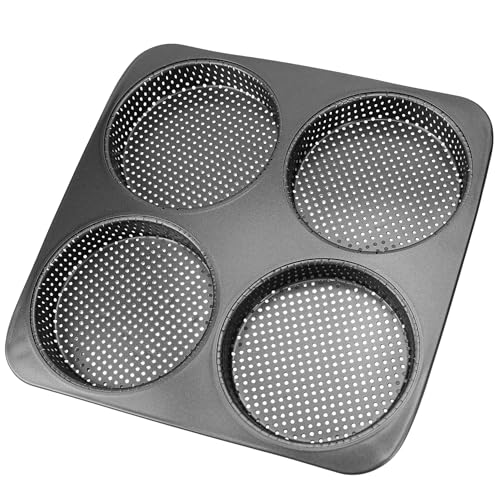
- Four five-inch cavities
- Perforated carbon-steel design
- Nonstick; oven-safe to 450°F
Best For: Wider buns for larger burgers
Best for Batch Prep
Dootafy Two-Pack Silicone Bun Molds

- Two pans make 12 portions
- 4-inch-wide, 0.75-inch-deep cavities
- Dishwasher-safe silicone
Best For: Shallow buns and batch-prepped breakfast eggs
Best All-Around Six-Cavity Pan

- Makes six 4-inch buns
- 1.57-inch-high mold
- Ventilated, dishwasher-safe silicone
Best For: A six-bun batch in a deeper silicone mold
Best Perforated Eight-Bun Mold
Mesh Silicone Hamburger Bun Pan

- Eight 3.93-inch bun forms
- Perforations let moisture escape
- Rolls up for compact storage
Best For: Larger batches with airflow-focused baking
Best Carbon Steel Option

- Six 3.5-inch-inner-diameter wells
- Coated carbon steel construction
- Greasing is recommended
Best For: Bakers who prefer a metal tray for smaller buns
Best Vented Silicone Option
Six-Cavity Bun Mold with Brush

- Six vented 4-inch cavities
- Dishwasher-safe silicone
- Not for liquid recipes
Best For: Shaped doughs that suit a perforated mold
Best Two-Pack
GDDGCUO Six-Cup Silicone Bun Pans

- Listed as two six-cup molds
- 4-inch-wide, 1.5-inch-deep cavities
- Confirm pack quantity before ordering
Best For: Larger batches of homemade burger buns
Most Versatile Set – TOPZEA Silicone Burger and Hot Dog Bun Pans
If your hamburger bun baking pan also needs to handle hot dog rolls, this TOPZEA set covers both shapes. It includes a six-cavity round bun mold, a separate hoagie-roll mold, and a scraper.
Best For: Home bakers who want burger buns and longer sandwich rolls from one set.
Pros:
- Two mold shapes accommodate round buns and longer rolls.
- Perforated bottoms promote airflow beneath the dough.
- Flexible, nonstick silicone is dishwasher-safe and rated to 446°F.
Cons:
- The round cavities measure 3.9 inches across, so they may be small for oversized burgers.
- Two pans take more storage space than a single mold.
Choose this set for flexibility rather than just burger-bun capacity; the included scraper is a useful extra when working with dough.
Best for Shallow Buns – Tiawudi 12-Cup Muffin Top Pan Set
This hamburger bun baking pan set is an option if you prefer shallow, evenly shaped rounds. Three carbon-steel pans provide four cavities each, giving you 12 spots for buns, muffin tops, or other small bakes.
Best For: Baking larger batches of shallow sandwich buns or muffin tops.
Pros:
- Three pans offer 12 cavities total.
- Four-inch top diameters create consistently sized rounds.
- Nonstick carbon steel is oven-safe to 450°F.
Cons:
- Half-inch-deep cavities are not suited to tall buns.
- Hand washing is recommended.
The shallow profile is the deciding factor: it suits muffin tops and flatter buns, but bakers seeking substantial burger rolls should consider a deeper mold.
Simple Silicone Pick – MUJUZE Six-Cavity Hamburger Bun Pan
For a straightforward hamburger bun baking pan without extra pieces, the MUJUZE mold gives you six round, four-inch cavities. Its vented silicone design is intended to encourage airflow around the buns as they bake.
Best For: Bakers who want a single flexible mold for standard-size homemade burger buns.
Pros:
- Six four-inch cavities shape a batch of uniform buns.
- Vented design promotes airflow during baking.
- Foldable silicone is dishwasher-safe and rated for oven use up to 230°C.
Cons:
- It is a single pan, with no hot dog roll mold or tools included.
- Silicone must be kept away from open flames and direct heat sources.
This is the focused choice for round buns: it trades the versatility of a multi-pan set for a simple, easy-to-store mold.
Best for Large Buns – BuleVina 5-Inch Carbon Steel Pan
If standard buns feel too small, this hamburger bun baking pan makes four five-inch rounds at a time. The BuleVina pan pairs perforated carbon steel with a nonstick coating and is rated for oven temperatures up to 450°F.
Best For: Making fewer, wider buns for larger burgers.
Pros:
- Four five-inch cavities suit larger buns.
- Perforations promote airflow for more uniform baking.
- Nonstick carbon steel is rated to 450°F.
Cons:
- Four cavities yield fewer buns per batch than six-cavity options.
- Hand washing is required.
Its wider cavities are the main reason to buy it. Check that five-inch buns match your preferred burger size before choosing this over a higher-capacity pan.
Best for Batch Prep – Dootafy Two-Pack Silicone Bun Molds
If you want a hamburger bun baking pan that can also handle breakfast prep, this two-pack offers 12 round cavities in total. Each cavity measures 4 inches across and 0.75 inch deep, making the molds useful for relatively shallow buns, baked eggs, and muffin tops.
Best For: Baking a dozen shallow buns or breakfast-sandwich eggs at once.
Pros:
- Two six-cavity pans provide 12 portions per batch.
- Flexible, nonstick silicone helps with removal and is dishwasher safe.
- Suitable for oven, microwave, and freezer use from -40°F to 446°F.
Cons:
- The 0.75-inch-deep cavities may not suit bakers who want taller buns.
- Flexible silicone may need a firm surface for moving filled pans.
Choose this set for portion count and versatility rather than deep bun shaping; its shallow cavities are especially well suited to eggs and muffin tops.
Best All-Around Six-Cavity Pan – Breathable Silicone Bun Mold
This hamburger bun baking pan makes six 4-inch rounds in one batch. Its 1.57-inch height offers more room than a shallow muffin-top mold, while the silicone construction and ventilated design aim to make homemade buns easier to bake and release.
Best For: Home bakers who want six standard-width buns from a reusable silicone mold.
Pros:
- Six 4-inch cavities suit a single batch of burger buns.
- Ventilation design promotes airflow during baking.
- Nonstick silicone is dishwasher safe and rated from -40°F to 446°F.
Cons:
- Only one six-cavity pan is included.
- The manufacturer recommends a little oil for easier release.
This is a practical middle-ground choice if six buns are enough for your household. Keep it away from open flames, as the product instructions specify.
Best Perforated Eight-Bun Mold – Mesh Silicone Hamburger Bun Pan
For bakers focused on airflow, this hamburger bun baking pan uses perforated silicone-and-fiberglass mesh to let moisture escape as buns bake. Its eight forms measure about 3.93 inches across and 1.57 inches deep, giving you room to make a larger batch of burger-size rolls.
Best For: Baking eight burger buns at once with a perforated mold.
Pros:
- Eight bun forms increase batch capacity.
- Perforated mesh allows airflow and moisture release.
- Nonstick, dishwasher-safe construction can be rolled up for storage.
Cons:
- The 17.1-by-12.2-inch footprint may not fit every baking setup.
- Mesh construction calls for care when cleaning and handling.
Its airflow-focused design sets it apart from solid silicone molds. Check your oven and supporting baking surface dimensions before choosing this larger format.
Best Carbon Steel Option – Yomvzake Six-Well Bun Pan
This hamburger bun baking pan uses a heavy-duty carbon steel tray with six round wells for shaping homemade buns. Each well has a stated 3.5-inch inner diameter, so check that size against the burgers you plan to serve.
Best For: Bakers who prefer a metal pan and want to make six smaller buns at once.
Pros:
- Carbon steel construction is designed to resist warping and rust.
- Double-layer nonstick coating helps baked goods release.
- Also suited to English muffins, whoopie pies, and muffin tops.
Cons:
- The maker recommends greasing or spraying the pan despite its nonstick coating.
- The stated 3.5-inch inner diameter is smaller than the 4-inch size in the title.
Choose this tray if you want the structure of metal bakeware. Its cavity measurement is worth checking before buying for larger burgers.
Best Vented Silicone Option – Six-Cavity Bun Mold with Brush
This hamburger bun baking pan is a flexible silicone mold with six perforated, 4-inch-wide cavities. The vented bottoms make it a choice for shaped doughs, but the maker explicitly rules out liquid recipes.
Best For: Bakers making burger rolls or other shaped doughs who want a vented silicone mold.
Pros:
- Six 4-inch-wide, 1.5-inch-deep cavities make a batch of buns.
- Flexible, nonstick silicone is dishwasher safe.
- Includes a basting brush and is rated for oven or fridge use from -40 to 446°F.
Cons:
- Perforated cavities are not suitable for liquid recipes.
The vents distinguish this mold from a solid-bottom pan. It makes the most sense when your recipes use dough that will stay in the cavities.
Best Two-Pack – GDDGCUO Six-Cup Silicone Bun Pans
This hamburger bun baking pan offering is listed as a two-pack of silicone molds, each with six 4-inch-wide, 1.5-inch-deep cavities. It suits bakers who want to shape more buns across multiple trays.
Best For: Baking batches of homemade burger buns with two six-cavity molds.
Pros:
- The stated package includes two six-cup pans.
- Food-grade silicone has no added nonstick coating.
- Dishwasher and microwave safe, with heat resistance stated up to 450°F.
Cons:
- The release instructions suggest oil or parchment for easier removal, despite the nonstick description.
- The listing’s package details are inconsistent: its bullets say two pans, while other fields say one item or component.
This is the option to consider for larger batches, provided you confirm the two-pack quantity when ordering.
How We Picked the Best Hamburger Bun Baking Pan
We focused on the details that matter when choosing a Hamburger Bun Baking Pan: cavity diameter and depth, the number of buns per batch, material, and features such as venting or perforation. The selection includes silicone molds, a carbon steel pan, shallow muffin-top-style pans, and one set intended primarily for longer rolls. Listed features help narrow the choices, but they do not establish how evenly a pan bakes or how easily buns release in every kitchen.
Quick Comparison: Which Pan Style Fits Your Batch?
Four-cavity round pans suit smaller batches or larger buns, depending on cavity diameter. Six-cavity round pans make more buns in one bake but may take up more oven space. Shallow muffin-top-style pans are worth considering if you want flatter, more uniform rounds; check their depth before expecting a tall bun. Perforated or vented molds allow more airflow around the dough, though results still depend on the recipe, oven, and baking surface. Long-roll molds are better suited to hot dog buns or sandwich rolls than standard round burger buns.
Key Buying Factors for a Hamburger Bun Baking Pan
Match the Cavity to Your Burger
A listed 4-inch cavity is a practical starting point for many homemade burgers, while a 5-inch cavity gives you room for a wider patty. Check whether the measurement refers to the top opening or the base: tapered molds can make buns narrower underneath. Depth matters too. A shallow cavity encourages a flatter bun, while a deeper mold leaves more room for vertical rise. Dough weight and proofing also affect the final size.
Choose a Material You Can Work with
Flexible silicone makes it easier to lift baked buns out, but a soft tray may need support from a rigid baking sheet when you move it. Carbon steel holds its shape without that extra support and can encourage browning where the dough contacts the pan. For either material, follow the maker’s temperature and cleaning instructions, and check whether a light coating of oil is recommended even if the pan is described as nonstick.
Check Capacity and Cleanup
Count cavities against the number of buns you usually need, then measure your oven rack and baking sheets before buying. Multiple pans can help with larger batches, provided air can circulate between them. If dishwasher cleanup matters, confirm that the specific model permits it rather than assuming every silicone mold does.
Who Should Buy Which Hamburger Bun Baking Pan?
For everyday family burgers, start with a six-cavity round mold sized to your usual patties. If you bake fewer, wider buns, consider a four-cavity pan with larger openings. Choose carbon steel if you prefer a rigid pan; choose silicone if flexibility and storage matter more. A vented or mesh design is worth considering if airflow is a priority, while a shallow muffin-top pan fits flatter buns. If your menu leans toward hot dogs or subs, buy a long-roll mold instead of trying to make round bun cavities do both jobs.