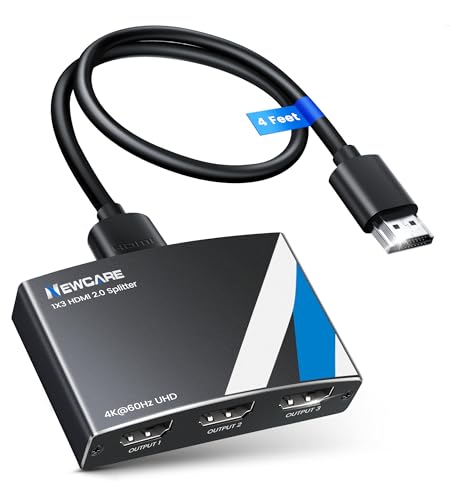
NEWCARE’s 4K@60Hz HDMI Splitter is built for a very specific job: taking one HDMI source and mirroring it to three displays.
If you need that exact workflow, this NEWCARE 4K@60Hz HDMI Splitter review shows why it is a straightforward, practical option rather than a general-purpose video distribution tool.
NEWCARE 4K@60Hz HDMI Splitter Review Summary
This NEWCARE 4K@60Hz HDMI Splitter makes sense for buyers who want one source duplicated across three screens with minimal setup.
It is most useful in living rooms, demo setups, classrooms, signage-style use cases, and home theaters where the same image must appear on every display.
The core strength is simplicity: one input, three mirrored outputs, built-in power, and auto downscaling so mixed-resolution displays can work together.
What it does not try to be is just as important.
It is not an extended desktop device, it does not support multiple inputs, and the listing says it cannot connect audio devices like speakers.
That means this product is for users who understand they are buying a mirroring splitter, not a switch, matrix, or AV receiver replacement.
For the right buyer, that narrow focus is exactly the appeal.
Review Scorecard
| Category | Score | Why it scores this way |
|---|---|---|
| Mirroring usefulness | 9/10 | Designed specifically to duplicate one HDMI source to three displays with synchronized output. |
| Format support | 8/10 | Supports 4K@60Hz, 1080p@120Hz, HDR10, Dolby Vision, and Dolby Atmos according to the listing. |
| Ease of setup | 9/10 | Plug-and-play bundle includes a power adapter, HDMI cable, and user guide. |
| Compatibility flexibility | 8/10 | Works with common sources like PCs, PS consoles, Fire TV sticks, TV boxes, and Blu-ray players. |
| Mixed-display handling | 8/10 | Auto downscaler helps 4K and 1080p displays work together at the same refresh rate. |
| Feature breadth | 5/10 | No extended mode, no input switching, and no support for audio devices. |
| Value for purpose | 8/10 | Strong fit if you need a powered 1-in-3 splitter and do not need extra AV routing features. |
Key Features and Specifications of NEWCARE 4K@60Hz HDMI Splitter
The main specification is simple: one HDMI input to three mirrored HDMI outputs.
The listing explicitly says it duplicates the same content on all screens and does not support extended mode, so it is best understood as a distribution tool rather than a productivity hub.
The product supports 4K at 60Hz and 1080p at 120Hz, along with HDR10, 3D, Dolby Vision, Dolby Atmos, and several audio formats including DTS and Dolby TrueHD.
It also supports HDMI 2.0 and HDCP 2.2, with the caveat that it is not compatible with higher versions.
That makes the compatibility picture fairly broad for mainstream AV gear, but still bounded by the listed standards.
Included in the box are:
- 1 HDMI 2.0 splitter
- 1 4 ft HDMI 2.0 cable
- 1 USB cable with power adapter
- 1 user guide
The listing also recommends AWG26 HDMI 2.0 cables and shorter cable runs for best results, especially at 4K.
It suggests up to 32.8 ft for 1080p and up to 16 ft for 4K on input/output lengths, which is a useful practical reminder that splitter stability depends on cabling quality.
The setup guidance is also specific: connect the displays first, then the input source, then plug in the 5V 1A adapter.
That sequence is meant to reduce flicker and blackouts, which is a useful detail for anyone who has used finicky HDMI gear before.
Pros and Cons of NEWCARE 4K@60Hz HDMI Splitter
Pros
- Mirrors one source to three displays, which is the entire point of the product and does it directly.
- Supports 4K@60Hz plus 1080p@120Hz, making it suitable for both modern and legacy screens.
- Auto downscaler is helpful when one display is 4K and another is 1080p.
- Includes the power adapter and a short HDMI cable, so the box is not bare-bones.
- Plug-and-play design reduces setup friction.
Cons
- Does not support extended displays, so it is not useful for multi-monitor productivity.
- No input switching, so it cannot act like a matrix or selector.
- Cannot connect audio devices like speakers, which limits certain AV setups.
- Best performance depends on cable length and cable quality, which can make real-world use more finicky than the core spec sheet suggests.
The biggest takeaway is that the pros and cons are tightly linked to the same design decision.
NEWCARE kept the product focused on mirroring, and that focus is useful only if mirroring is exactly what you need.
Who Should Buy NEWCARE 4K@60Hz HDMI Splitter?
Buy this if you need to send one HDMI source to three identical displays and want a powered splitter that is easy to understand.
It is a sensible fit for situations like shared content in a room, duplicated TV output, projector plus screen mirroring, or source replication for demos and presentations.
It is also a good match if you care about mixed-resolution handling.
The auto downscaler makes the splitter easier to use when not every display in the chain can accept the same native signal.
You should probably skip it if you want:
- An extended desktop for work
- An HDMI switch for multiple sources
- An AV hub with speaker support
- A more flexible routing setup for complex home theater or studio wiring
In other words, this is not for buyers who need versatility first.
It is for buyers who need a mirror-first splitter and want that job done with minimal fuss.
Signal Handling and Setup Practicality of NEWCARE 4K@60Hz HDMI Splitter
Mirror-Only Output
The listing is clear that this device duplicates one source across three displays.
That makes it useful for synchronized viewing, but it also means the product has no productivity-style extended desktop mode.
If you need one screen for work and another for reference material, this is the wrong tool.
Downscaling Across Mixed Displays
Auto downscaling is one of the more practical features here.
It suggests the splitter can help a 4K display and a 1080p display coexist in the same setup without forcing every screen to accept the same native output format.
That is the kind of detail that matters in real rooms where displays are rarely identical.
Cable Length and Signal Stability
The listing’s cable recommendations are not filler.
Shorter runs are advised for 4K, and the product notes mention screen flickering and blackouts can be prevented by following the proper connection sequence and using the power adapter.
That implies the hardware is intended for careful, basic AV use rather than careless long-distance cabling.
Source Compatibility
The supported source examples are broad enough for most mainstream consumers: PC, PS5, PS4, PS3, Fire TV stick, TV box, and Blu-ray player.
That makes the splitter broadly compatible in practice, but still centered on standard HDMI use rather than unusual edge cases.
Alternatives to NEWCARE 4K@60Hz HDMI Splitter
If you want similar products from familiar HDMI accessory brands, these are credible places to compare:
- UGREEN HDMI splitter search
- OREI HDMI splitter search
- J-Tech Digital HDMI splitter search
- Fosmon HDMI splitter search
Those alternatives are worth checking if you want different port counts, different form factors, or a brand with a separate lineup focused on AV accessories.
For this comparison, the key question is not which splitter is “best” in the abstract, but which one matches your source count, display count, and mirroring needs.
Is NEWCARE 4K@60Hz HDMI Splitter Worth It?
Yes, if you want a simple 1-in-3 mirroring splitter and nothing more. The NEWCARE 4K@60Hz HDMI Splitter has a clear use case, useful resolution support, and a practical accessory bundle.
Its auto downscaling and plug-and-play setup make it easy to justify for multi-display mirroring jobs.
No, if you need flexibility. The lack of extended mode, input switching, and speaker support means this is deliberately narrow hardware.
If that narrow design matches your setup, it is worth considering.
If not, you should look at a more flexible HDMI distribution or switching solution instead.