The best food strainer machines make it easier to process tomatoes, apples, berries, pumpkins, and other produce without peeling or seeding everything by hand. The right model can save time while producing smoother sauces, purées, and preserves.
This roundup compares manual, mixer-powered, and electric options for occasional home use, batch cooking, and higher-volume food processing. Consider capacity, cleanup, power, and the textures you want before choosing.
Best 10 Food Strainer Machines Picks for 2026
Best Electric-Powered Food Strainer Machine

- Includes four screens for varied textures
- Hand crank and electric motor included
- Five-year warranty with strong clamp mount
Best For: Motor-assisted sauces, purees, jams, and seasonal produce
Best Simple Sauce Maker
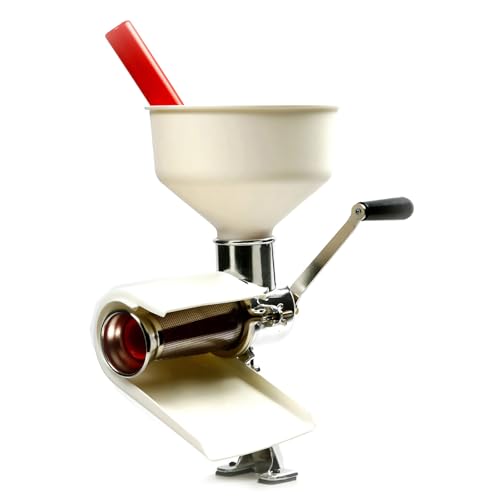
- 3-quart capacity for fruits and vegetables
- Separates juice and pulp in one operation
- Includes fine screen and recipe booklet
Best For: Straightforward hand-crank sauce and puree preparation
Best KitchenAid-Compatible Food Strainer Machine

- Strainer and meat grinder in one set
- Removes skins, seeds, and stems from cooked produce
- Removable dishwasher-safe parts and brush included
Best For: KitchenAid owners making sauces, purees, ground meat, and sausage
Best Basic Hand-Crank Food Strainer Machine

- Apple/tomato screen included
- Optional motor and specialty screens available
- Five-year warranty with secure clamp mount
Best For: Starter sauce, puree, juice, and jam preparation
Large-Batch Classic
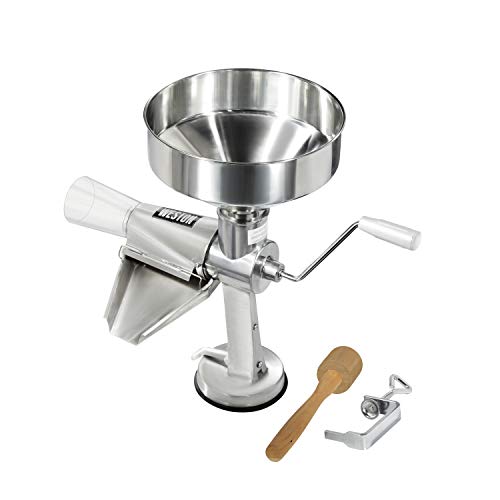
- 1-gallon stainless steel hopper
- Dual suction-cup and C-clamp mounting
- Includes 1.5mm screen and stomper
Best For: Large batches of tomato sauce, purees, jams, and preserves
Versatile Countertop Filter

- 1.5-liter pitcher capacity
- 0.5mm stainless steel mesh
- Includes press stick and cleaning brush
Best For: Greek yogurt, nut milk, soy milk, juice, and tea
Powered Harvest Helper
VEVOR Electric Tomato Strainer

- Electric motor for continuous processing
- Four screens from 1mm to 6mm
- 304 stainless steel components
Best For: Large-batch sauces, purees, salsa, jam, and canning
Best All-Around Home Canning Pick
Weston Deluxe Electric Tomato Strainer

- 250-watt two-speed motor with reverse
- One-gallon hopper for larger batches
- Three screens for varied textures
Best For: Home canning, sauces, purees, and salsa
Best Commercial-Style Stainless Option
VBENLEM 370W Tomato Milling Machine
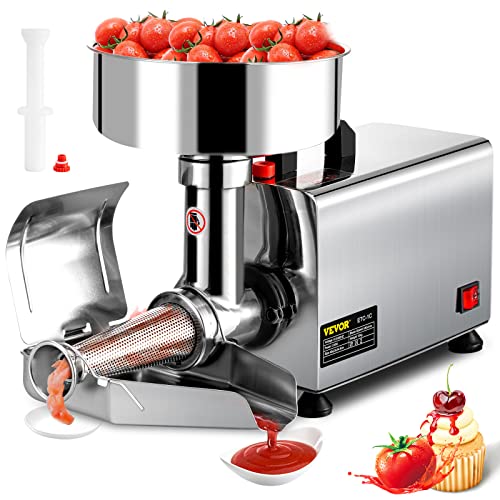
- 370-watt pure copper motor
- Food-contact 304 stainless steel parts
- Nine-inch funnel with adjustable trough
Best For: Higher-volume sauces, ketchup, and berry jams
Best for Bulk Harvest Processing
VEVOR 370W Electric Tomato Strainer

- 370-watt motor for large batches
- Stainless steel processing components
- Tool-free disassembly for quick cleaning
Best For: Bulk canning, tomato sauce, puree, and jam
Best Electric-Powered Food Strainer Machine – Johnny Model 250 with Motor
For shoppers comparing food strainer machines, this Johnny Model 250 stands out by combining a hand crank with an included electric motor. Its interchangeable screens make it suitable for sauces, purees, jams, juices, and other fruit and vegetable preparations.
Best For: Home cooks and gardeners who want broad screen options and motor-assisted straining for larger batches.
Pros:
- Includes berry, apple/tomato, pumpkin, and salsa screens.
- Can be used manually or with the included electric motor.
- Sturdy clamp fits countertops from 3/4 to 2-1/8 inches thick.
- Includes a five-year warranty and BPA-free plastic components.
Cons:
- The included accessories and motor make it a larger, heavier setup.
- Its clamp-based design requires a suitable countertop edge.
This is the most versatile option in the group if you want one machine for both fine and chunky preparations. The extra screens and included motor add convenience, though the setup is more substantial than a basic hand-crank model.
Best Simple Sauce Maker – Norpro 1951 Sauce Master
The Norpro 1951 is a straightforward choice among food strainer machines, using a hand-operated mechanism to push produce through a chrome-plated steel screen while separating juice and pulp. Its 3-quart capacity suits routine sauce and puree preparation.
Best For: Cooks seeking a simple hand-crank strainer for vegetables, fruits, and purees.
Pros:
- Handles up to 3 quarts, or 95 ounces.
- Automatically separates juice and pulp in one operation.
- Includes a standard fine mesh screen, spiral, recipes, and instructions.
- Additional berry, pumpkin, and salsa screens are available separately.
Cons:
- Only the standard screen is included.
- Additional specialty screens cost extra.
- Hand wash only according to the listed product highlight.
The Sauce Master is a practical pick when you want the core straining function without an included motor or extensive accessory bundle. It offers useful capacity, but shoppers wanting multiple textures will need to purchase extra screens.
Best KitchenAid-Compatible Food Strainer Machine – InnoMoon 2-in-1 Set
This InnoMoon set expands a compatible KitchenAid stand mixer into a food strainer machine for cooked fruits and vegetables, while also including a meat grinder attachment. The strainer is designed to filter out skins, seeds, and stems as the mixer processes the ingredients.
Best For: KitchenAid owners who want straining and meat-processing functions in one accessory set.
Pros:
- Combines a fruit and vegetable strainer with a meat grinder.
- Filters skins, seeds, and stems from cooked produce.
- Includes grinding plates, cutting blades, sausage tubes, and a fixing ring.
- Removable parts are dishwasher safe, and a cleaning brush is included.
Cons:
- Requires a KitchenAid stand mixer for operation.
- Hard or firm fruits and vegetables should be cooked first.
- Made primarily from plastic and has a one-year warranty.
This is a space-saving option for KitchenAid users who value versatility beyond straining. Its main limitation is compatibility: it is not a standalone machine and works best when produce is prepared as directed.
Best Basic Hand-Crank Food Strainer Machine – Johnny Model 250
This basic Johnny Model 250 is a focused option for shoppers comparing food strainer machines. It uses a hand crank and an apple/tomato screen to separate skins and seeds for sauces, purees, juices, jams, and other fruit or vegetable recipes.
Best For: Home cooks who want a durable clamp-mounted starter strainer and may add specialty screens later.
Pros:
- Includes an apple/tomato screen with 1.3 mm holes.
- Works with an optional electric motor sold separately.
- Cast aluminum body and stainless steel screen are designed for durability.
- Clamp mounts to countertops from 3/4 to 2-1/8 inches thick.
Cons:
- Only the standard screen is included.
- Berry, pumpkin, and salsa screens must be purchased separately.
- The electric motor is optional rather than included.
This model makes sense for buyers who prefer a capable hand-crank foundation and want to control accessory costs. It is less immediately versatile than the motorized bundle, but its compatible add-ons allow the setup to grow over time.
Large-Batch Classic – Weston Metal Tomato Strainer
For shoppers comparing food strainer machines for homemade sauces and preserves, the Weston Metal Tomato Strainer is a manual option built around a roomy 1-gallon hopper. Its stainless steel construction, smooth-turning handle, and included 1.5mm screen help separate skins and seeds from soft fruits and vegetables without peeling or coring first.
Best For: Home cooks processing large batches of tomatoes, apples, jams, preserves, sauces, purees, and salsa.
Pros:
- One-gallon hopper supports larger batches.
- Dual suction-cup and C-clamp mounting works on various flat surfaces.
- Stainless steel splash guard and chute help direct puree with less mess.
- Includes a stomper and 1.5mm multipurpose screen.
Cons:
- Additional screens require a separately sold accessory kit.
- Manual operation requires turning the handle.
This Weston model is a practical choice when you want durable materials and generous capacity without using an electric motor. It is especially suited to seasonal canning and sauce-making projects where flexible mounting matters.
Versatile Countertop Filter – Podoy Yogurt Strainer Maker
Among food strainer machines for everyday kitchen use, the Podoy Multiple Usage Food Strainer is a compact 1.5-quart pitcher system designed for more than tomato processing. Its stainless steel mesh filter can be used for Greek yogurt, nut milk, soy milk, juices, and tea.
Best For: Home cooks who want one countertop strainer for yogurt, plant-based milk, juice, and tea.
Pros:
- Transforms up to 1 quart of plain yogurt into Greek yogurt.
- 0.5mm stainless steel mesh supports fine filtering.
- Suitable for yogurt, nut milk, soy milk, fruit and vegetable juice, and tea.
- Includes pitcher, handle, press stick, filter, and cleaning brush.
Cons:
- Its 1.5-liter pitcher is smaller than large-batch sauce machines.
- Plastic components are included alongside the stainless steel mesh.
The Podoy is a flexible choice for smaller portions and varied recipes. Its included press stick and cleaning brush add convenience, while the fine mesh makes it more appropriate for filtered dairy, milk, juice, and tea than heavy-duty fruit pressing.
Powered Harvest Helper – VEVOR Electric Tomato Strainer
For shoppers seeking food strainer machines for continuous sauce making, the VEVOR Electric Tomato Strainer provides motorized processing with an 800W maximum rating and 300W rated power. Its stainless steel filter separates peels and seeds in one pass, while four interchangeable screens support different textures and recipes.
Best For: Large-batch tomato processing, harvest-season canning, sauces, purees, salsa, and strawberry jam.
Pros:
- Electric DC motor provides steady, high-torque operation with low noise.
- Includes 1mm, 1.5mm, 3mm, and 6mm screens for varied textures.
- 304 stainless steel parts resist fruit acids and wear.
- Guard cover helps reduce splatter, and core components are removable without tools.
Cons:
- Requires access to electrical power.
- At 7.2 pounds, it is less lightweight than a small manual strainer.
- Its motorized design may be more equipment than occasional users need.
The VEVOR stands out for speed and repeatability when processing substantial quantities. The included screen range makes it more adaptable than a single-screen machine, while the removable components and cleaning brush simplify cleanup after busy batches.
Best All-Around Home Canning Pick – Weston Deluxe Electric Tomato Strainer
The Weston Deluxe is a practical choice among food strainer machines for home cooks who want to turn tomatoes and soft produce into sauces, purees, jellies, or salsa. Its 250-watt, two-speed motor, one-gallon hopper, and three interchangeable stainless steel screens provide useful flexibility for small-to-large preservation projects.
Best For: Home canning, garden harvests, sauces, purees, jellies, and chunky salsa.
Pros:
- Three screens support fine, multipurpose, and chunkier results.
- Forward and reverse motor speeds help with processing and jam prevention.
- One-gallon hopper reduces frequent refilling during batch work.
- Includes a stomper for safely feeding produce.
Cons:
- The plastic-and-stainless-steel construction may be less heavy-duty than an all-stainless commercial machine.
- Its 250-watt motor is less powerful than the 370-watt alternatives listed here.
Choose this model if adjustable texture and versatile home preserving matter more than maximum throughput. The reverse function and included stomper are especially useful for occasional batch processing.
Best Commercial-Style Stainless Option – VBENLEM 370W Tomato Milling Machine
The VBENLEM is one of the more substantial food strainer machines for users processing sauces and jams in larger quantities. It combines a 370-watt pure copper motor with food-contact 304 stainless steel components, a nine-inch funnel, and an adjustable discharge trough.
Best For: Higher-volume tomato milling, ketchup, berry sauces, and jam preparation.
Pros:
- Food-contact parts are made from 304 stainless steel.
- 370-watt pure copper motor is suited to demanding processing.
- Nine-inch funnel supports generous feeding of fruit.
- Adjustable trough and brace help direct sauce and reduce splashing.
Cons:
- At 22 pounds, it is heavier and less convenient to move than a compact home unit.
- The supplied notes describe one strainer configuration rather than multiple interchangeable screens.
- Its larger commercial-style design may be more than needed for occasional small batches.
This VBENLEM model makes sense when durable food-contact materials and a stronger motor are priorities. Its funnel and adjustable trough also suit users who value smoother feeding and discharge during extended sauce-making sessions.
Best for Bulk Harvest Processing – VEVOR 370W Electric Tomato Strainer
The VEVOR is a strong contender among food strainer machines for harvest-season batches and frequent canning. Its 370-watt motor, large hopper, stainless steel processing components, and tool-free disassembly are designed to move tomatoes efficiently while simplifying cleanup.
Best For: Bulk tomato processing, smooth sauce and puree, jam making, and frequent cleanup.
Pros:
- 370-watt motor supports high-volume sauce making.
- Stainless steel hopper, filter screen, juice tray, and guard resist fruit acids and wear.
- Large hopper helps reduce the number of refills.
- Core components disassemble without tools for quick rinsing.
Cons:
- Tomatoes should be cut into small pieces to help reduce clogging.
- The supplied notes mention a stainless filter screen but do not specify multiple screen sizes.
- Its approximately 21.7-pound body is less portable than a lightweight home appliance.
Consider the VEVOR when throughput, stainless construction, and easy post-batch cleaning are more important than compact storage. It is particularly well matched to repeated processing during a productive harvest season.
How We Picked the Best Food Strainer Machines
We compared these Food Strainer Machines by operating style, intended workload, material quality, hopper and output capacity, versatility, and ease of cleanup. The selection includes clamp-based manual strainers, a KitchenAid attachment, food mills, yogurt strainers, and electric tomato-processing machines.
Because these tools serve different kitchens, performance should be judged against your typical batch size rather than maximum advertised throughput alone. Electric models are usually faster, while manual and attachment-based options can be more compact and affordable.
Quick Comparison
| Type | Best For | Main Advantage | Potential Trade-Off |
|---|---|---|---|
| Manual clamp strainer | Small home batches | Simple, affordable operation | Requires hand cranking |
| KitchenAid attachment | Existing stand-mixer owners | Uses a motor you already have | Requires compatible mixer and storage |
| Food mill or yogurt strainer | Purées and soft foods | Useful for varied ingredients | May process more slowly |
| Electric countertop strainer | Frequent sauce making | Less manual effort | Higher cost and cleanup requirements |
| Commercial-style electric machine | Large harvests and heavy batches | High potential throughput | Larger footprint and louder operation |
Key Buying Factors for Food Strainer Machines
Manual or Electric Operation
Manual machines are practical when you process occasional batches and want fewer electrical components. Electric models are better for repeated processing or large harvests, but verify the motor rating, duty cycle, and whether the advertised capacity reflects real-world conditions.
Food Compatibility
Check whether the strainer is designed for tomatoes, apples, berries, pumpkins, cooked vegetables, yogurt, or multiple food types. Screen design affects how well the machine separates skins and seeds and how smooth the finished product becomes.
Capacity and Throughput
A larger hopper reduces refilling, while higher throughput matters for canning and preserving. Do not choose solely by a claimed pounds-per-hour figure; the result can vary with ingredient ripeness, preparation, screen size, and operator technique.
Construction and Stability
Stainless steel and durable metal components are useful for frequent processing and easier sanitation. Clamp-based models need a compatible, stable work surface, while electric units need enough counter space and a secure feed area.
Cleaning and Replacement Parts
Look for removable screens, augers, and trays that can be rinsed promptly after use. Before buying, confirm that replacement screens, gaskets, and other wear parts are available if you plan to use the machine for years.
Who Should Buy Which Food Strainer Machines?
- Choose a manual clamp model if you want an economical tool for small batches of apples, tomatoes, salsa ingredients, or pumpkin.
- Choose the KitchenAid attachment if you already own a compatible stand mixer and want to avoid another motorized appliance.
- Choose a versatile food mill or strainer if you process several soft foods and value flexibility over maximum speed.
- Choose a countertop electric model if you make sauces regularly and want to reduce hand cranking.
- Choose a commercial-style machine if you process garden or farm harvests in large quantities and have room for a heavier appliance.
For most shoppers, the best choice balances batch size, ingredient types, available storage, and cleanup time. Match the machine to your normal workload rather than buying the most powerful model by default.