Small-batch sauce production becomes much easier with the right tomato press. The best models separate skins and seeds efficiently while helping cafés, farm shops, caterers, and small food businesses process consistent quantities with less manual labor.
We compared 10 electric and manual tomato strainers across motor power, construction, capacity, cleaning practicality, and commercial-use features. This guide highlights what matters most before you choose a machine for your workflow.
Best 10 Tomato Presses for Small Businesses Picks for 2026
High-Output Electric Pick

- Processes up to 330 pounds per hour
- Automatic seed and skin separation
- 220V, 1/4 HP motor with cooling fan
Best For: High-volume tomato processing
Commercial Stainless-Steel Choice

- Processes sauce, jams, and fruit juice
- AISI 304 stainless-steel food-contact parts
- Includes one-year parts-and-labor warranty
Best For: Small restaurants and versatile batch processing
Manual Flexible-Mount Option
Weston Stainless Steel Tomato Strainer
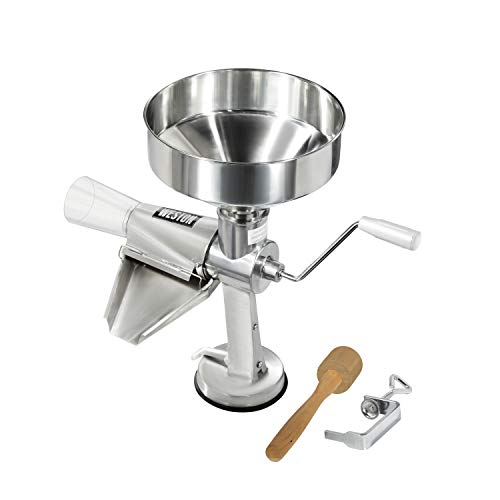
- One-gallon hopper for batch work
- Suction-cup and C-clamp mounting
- Includes stomper and 1.5 mm screen
Best For: Portable, manual small-batch processing
Heavy-Duty Italian Workhorse

- Processes up to 309 pounds per hour
- 450W induction motor for continuous operation
- Durable cast iron and AISI 304 stainless steel
Best For: Recurring, high-volume sauce and preserve production
Commercial Capacity Pick
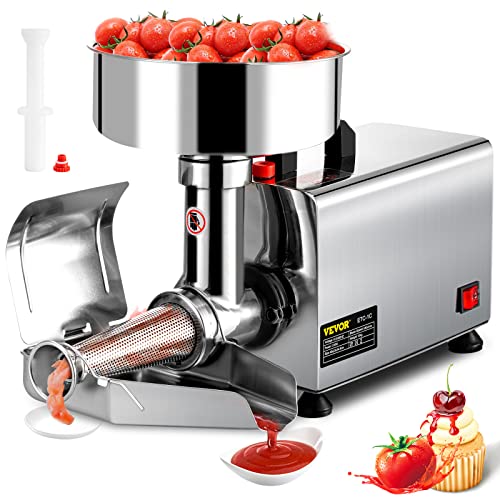
- 90–160 kg/h capacity listed
- 304 stainless-steel food-contact parts
- 9-inch funnel and adjustable trough
Best For: Small businesses handling substantial sauce and jam batches
Flexible Texture Choice
VEVOR Electric Tomato Strainer

- Four screens for varied textures
- Steady, low-noise DC motor
- Removable parts and cleaning brush
Best For: Small businesses producing sauces, purees, salsa, and jams
Warranty-Backed Workhorse

- Up to 330 lb/h stated capacity
- 304 stainless steel with safety guard
- 5-year warranty and lifetime support
Best For: Restaurants, farms, and commercial kitchens needing high output
Best All-Around Pick
Weston Deluxe Electric Tomato Strainer

- 250-watt motor with forward and reverse speeds
- One-gallon hopper for batch processing
- Three stainless steel screens included
Best For: Versatile sauce, puree, jam, and salsa production
Commercial Efficiency Pick
Newhai Electric Tomato Strainer

- 450-watt motor with output up to 110 pounds per hour
- Wide 8.4-inch stainless steel funnel
- Enclosed motor housing and removable parts
Best For: Small commercial kitchens processing sauces and fruit jams
High-Throughput Stainless Pick
INTBUYING Electric Tomato Strainer

- 450-watt motor rated up to 330 pounds per hour
- Food-grade stainless steel construction
- Adjustable trough helps reduce splashing
Best For: Restaurants and cafés processing large sauce batches
High-Output Electric Pick – OMRA Spremy Model 850
For small businesses needing tomato presses for small businesses with dependable batch capacity, the OMRA Spremy Model 850 offers electric operation and tomato processing rated up to 330 pounds per hour. Its masticating-style worm and food-grade components suit fresh or cooked tomato production.
Best For: Small food businesses and serious producers processing high volumes of tomatoes.
Pros:
- Rated capacity of up to 330 pounds of tomatoes per hour.
- Separates puree from seeds and skin automatically.
- Stainless steel hopper, die-cast metal housing, and food-grade nylon auger.
- Cooling-fan-equipped 1/4 HP motor with 110 RPM worm rotation.
Cons:
- Requires a 220-volt electrical supply.
- Designed primarily around tomato and apple processing.
The Model 850 is a strong fit when throughput and automated separation matter most. Confirm your electrical setup before choosing it for a commercial workspace.
Commercial Stainless-Steel Choice – Omcan 18901 Tomato Squeezer
The Omcan 18901 is a practical option among tomato presses for small businesses, combining a cast-iron body with built-in AISI 304 stainless-steel processing parts. Its 0.3 HP motor handles tomatoes, jams, and fruit juice, while the included guard and drip pan support cleaner operation.
Best For: Small restaurants and food businesses making tomato sauce, jams, or fruit juice.
Pros:
- Separates seeds and skins from fruits and vegetables.
- Stainless-steel filter cone, funnel, drip pan, and anti-spray guard.
- Dishwasher-safe care instruction is provided.
- Includes a one-year parts-and-labor warranty.
Cons:
- Operates at one speed only.
- Its 110-watt motor is less powerful than the higher-wattage models listed here.
- Large 20.5-inch depth may require substantial counter space.
Choose this Omcan when stainless-steel food-contact parts, broader fruit uses, and warranty coverage are priorities. Its single-speed design keeps operation straightforward but offers less control.
Manual Flexible-Mount Option – Weston Stainless Steel Tomato Strainer
For small businesses that prefer a simple manual setup, the Weston stainless-steel strainer is a compact alternative among tomato presses for small businesses. Its one-gallon hopper, hand-turned handle, and dual mounting system support batch processing without an electrical connection.
Best For: Small-batch producers who need portable, manually operated tomato and fruit processing.
Pros:
- One-gallon hopper supports larger batches than many countertop manual tools.
- Dual mount uses a suction-cup base and C-clamp.
- Includes a stomper and 1.5 mm screen for tomatoes and apples.
- Splash guard and chute help direct puree and reduce mess.
Cons:
- Manual operation requires more labor than electric presses.
- Additional screens are sold separately.
- Supplied information does not specify an hourly processing capacity.
The Weston makes sense where portability, mounting flexibility, and no electrical requirement outweigh maximum throughput. Consider the optional accessory kit if your business needs more puree textures or ingredients.
Heavy-Duty Italian Workhorse – Reber N.3 Electric Strainer
The Reber N.3 is built for businesses seeking tomato presses for small businesses with continuous-duty capability. Its 450W induction motor is rated to process up to 309 pounds per hour, while the oil-bath gearbox and stainless-steel processing components are designed for repeated sauce and preserve production.
Best For: Small businesses handling large, recurring batches of tomato sauce, preserves, jams, or juice.
Pros:
- Continuous motor operation with capacity up to 309 pounds per hour.
- Maintenance-free Long Life oil-bath gearbox.
- Food-safe epoxy-coated cast-iron body and AISI 304 stainless-steel parts.
- Compatible optional attachments can expand its functions beyond straining.
Cons:
- Hand-wash-only care may increase cleanup time.
- At 21 pounds, it is less convenient to move frequently.
- Optional attachments are needed for expanded functions.
The Reber N.3 is the most production-oriented choice in this group, particularly for operators who value continuous processing and durable construction. Its size and hand-wash requirement are trade-offs for that capability.
Commercial Capacity Pick – VBENLEM 370W Tomato Press
For small businesses that need tomato presses for small businesses with substantial batch capacity, the VBENLEM combines a 370W pure copper motor with a 9-inch feeding funnel. Its stainless-steel food-contact components and adjustable discharge trough make it suited to producing sauces and fruit-based preparations in a commercial setting.
Best For: Small businesses processing large batches of tomatoes, sauces, or jams.
Pros:
- Rated capacity of 90–160 kg per hour in the product title.
- Food-contact parts use 304 stainless steel.
- Large 9-inch funnel supports efficient feeding.
- Adjustable trough helps direct sauce during discharge.
Cons:
- At 22 pounds, it is less convenient to move frequently.
- Its 110V power requirement may not suit every commercial workspace.
The VBENLEM is a practical high-throughput option when batch volume matters more than portability. Its easy-to-disassemble design and low-noise operation also support regular production and cleanup.
Flexible Texture Choice – VEVOR Electric Tomato Strainer
The VEVOR is one of the more adaptable tomato presses for small businesses because it includes four interchangeable screens. It separates peels and seeds while letting operators choose finer or coarser textures for tomato sauce, purees, salsa, and other preparations.
Best For: Small food businesses that make several products with different texture requirements.
Pros:
- Includes 1 mm, 1.5 mm, 3 mm, and 6 mm screens.
- 304 stainless-steel components resist fruit acids and wear.
- DC motor is designed for steady, low-noise operation.
- Removable core components and included brush simplify cleaning.
Cons:
- Listed capacity is 40 kg, lower than some larger commercial models.
- The 7.2-pound weight may indicate a lighter-duty build for very high-volume use.
Choose this VEVOR model when versatility is more important than maximum throughput. The screen selection can help a small producer accommodate varied recipes without buying separate straining equipment.
Warranty-Backed Workhorse – ARINOO 450W Tomato Strainer
The ARINOO is a strong candidate among tomato presses for small businesses that want high stated output and long-term support. Its dual-channel straining design separates skins and seeds, while the 450W pure copper motor is rated for processing up to 330 pounds per hour.
Best For: Restaurants, farms, and commercial kitchens seeking high stated throughput and warranty coverage.
Pros:
- Processes up to 330 pounds per hour according to the supplied details.
- Food-grade 304 stainless steel construction is rust-resistant.
- Includes a safety guard, enclosed motor housing, and food pusher.
- Backed by a 5-year manufacturer warranty and lifetime customer service.
Cons:
- Requires a 5-minute cooldown after every 15 minutes of continuous use.
- Hand-wash-only care may take more time during busy production periods.
- At 20.9 pounds, it is not especially portable.
The ARINOO stands out for businesses prioritizing output, safety features, and after-sales support. The required cooldown schedule should be considered when planning uninterrupted production runs.
Best All-Around Pick – Weston Deluxe Electric Tomato Strainer
For small businesses seeking versatile tomato presses, the Weston Deluxe balances batch capacity with flexible straining. Its 250-watt motor, one-gallon hopper, reverse function, and three included screens make it suitable for sauces, purees, jams, and salsa.
Best For: Small food businesses processing varied batches of tomatoes, berries, and soft produce.
Pros:
- One-gallon hopper supports larger batches.
- Three stainless steel screens handle fine, medium, and chunky preparations.
- Two speeds include reverse to help prevent jamming.
- Includes a stomper for safer feeding.
Cons:
- Its 250-watt motor is less powerful than the commercial 450-watt alternatives.
- Plastic and stainless-steel construction may be less substantial than an all-stainless commercial machine.
The Weston is a practical choice when flexibility matters more than maximum throughput. It also includes a one-year manufacturer warranty, adding useful coverage for small operations.
Commercial Efficiency Pick – Newhai Electric Tomato Strainer
Among tomato presses for small businesses, the Newhai stands out for its commercial-oriented design and stated output of up to 110 pounds of jam per hour. Its 450-watt motor, stainless steel funnel, and enclosed motor housing are suited to steady sauce and fruit-processing work.
Best For: Dessert shops, fruit markets, and other small commercial kitchens needing efficient batch processing.
Pros:
- 450-watt motor is designed for high-efficiency processing.
- Large 8.4-inch funnel accepts substantial amounts of raw material.
- Enclosed motor casing provides added protection compared with exposed-motor designs.
- Removable components can be rinsed separately for easier cleanup.
Cons:
- Hand washing is required according to the care instructions.
- The product notes do not specify included interchangeable screens.
The Newhai is a focused commercial option for businesses prioritizing throughput and stainless-steel construction. Its included pestle and straightforward assembly also support routine operation.
High-Throughput Stainless Pick – INTBUYING Electric Tomato Strainer
The INTBUYING is a strong candidate for small businesses that need higher stated throughput from tomato presses. It combines a 450-watt motor with food-grade stainless steel construction and a listed capacity of up to 330 pounds of ketchup per hour.
Best For: Restaurants, cafés, and small producers handling extended batches of tomato sauce or fruit purees.
Pros:
- 450-watt motor is rated for up to 330 pounds of ketchup per hour.
- Food-grade stainless steel construction is durable and easy to clean.
- Immersive funnel accommodates larger amounts of fruit.
- Adjustable trough and support help direct sauce and reduce splashing.
Cons:
- Its 21.06-inch length requires more counter space than the Weston.
- The notes do not mention interchangeable screens or a reverse function.
Choose the INTBUYING when throughput, stainless-steel construction, and extended operation are more important than compactness. It also supports strawberries, blueberries, raspberries, and other fruit preparations beyond tomato sauce.
How We Picked the Best Tomato Presses for Small Businesses
We focused on machines suited to regular sauce, purée, and preserve production rather than occasional household use. The selection includes compact electric strainers, higher-output commercial milling machines, and a manual stainless-steel option for businesses that value simplicity or need a backup during power interruptions.
Our comparison emphasizes motor power, stated throughput, hopper and chute design, food-contact materials, ease of cleaning, expected workload, and the practical space requirements of each model. Because manufacturer capacity ratings can vary by tomato variety, preparation, and operating technique, treat them as useful benchmarks rather than guaranteed production speeds.
Quick Comparison
| What to Compare | Why It Matters |
|---|---|
| Motor power | Higher power can help with longer runs and tougher, less-prepared tomatoes, but it may also increase noise and energy use. |
| Throughput | Match the claimed capacity to your typical batch size, allowing time for feeding, clearing, cleaning, and setup. |
| Construction | Stainless-steel food-contact parts are generally easier to sanitize and better suited to frequent commercial use. |
| Operation | Electric models reduce physical effort; manual presses offer straightforward control and no motor to maintain. |
| Cleaning | Removable screens, funnels, augers, and splash guards can significantly reduce end-of-day labor. |
Key Buying Factors for Tomato Presses for Small Businesses
Capacity and Duty Cycle
Estimate how many tomatoes you process per session and how often you operate the machine. A compact unit may be sufficient for a café or farm stand making occasional batches, while a restaurant, caterer, or producer selling packaged sauce should prioritize a commercial-duty design and suitable continuous-run limits.
Power and Output
Wattage alone does not determine performance. Look at the motor design, auger efficiency, screen size, stated kilograms-per-hour rating, and whether tomatoes need to be softened or quartered first. A model with moderate power may outperform a higher-wattage machine if its feed system is better matched to your ingredients.
Materials, Safety, and Sanitation
Choose food-safe construction, stable feet, protected moving parts, and controls that are easy to reach. Confirm which components can be removed for washing and whether the manufacturer provides replacement screens, augers, gaskets, or other wear parts. Never immerse an electric motor housing unless the instructions specifically allow it.
Space and Workflow
Measure your counter or prep table, including clearance for the hopper, collection containers, and pulp outlet. A machine that fits the workspace but forces awkward container placement can slow production. Consider storage, cord placement, and whether you can feed tomatoes continuously without blocking other prep tasks.
Who Should Buy Which Tomato Presses for Small Businesses?
Choose a compact electric strainer if you process modest batches and want fast, low-effort operation. Choose a higher-output commercial model if tomato processing is a recurring revenue-producing task and downtime would be costly. A manual stainless-steel press can suit very small operations, mobile setups, or businesses that want a simple backup. For any of these Tomato Presses for Small Businesses, verify local food-service requirements, electrical compatibility, warranty coverage, and replacement-part availability before ordering.