Making fresh tomato sauce does not require a large appliance or a dedicated canning room. The right tomato press can separate skins and seeds efficiently while taking up relatively little counter or cabinet space.
We selected 10 options for different kitchen setups, including compact food mills, clamp- or suction-mounted presses, and an electric model for larger batches. Use the guide below to match capacity, cleanup, storage, and pressing effort to the way you cook.
Best 10 Tomato Presses for Small Kitchens Picks for 2026
Best Compact Suction-Mount Pick

- Separates skins and seeds
- Suction base supports stability
- Includes stainless steel pusher
Best For: Small-batch tomato juice, puree, and salsa
Best Adjustable-Texture Mill
Hungry Artisan 3-Disc Food Mill
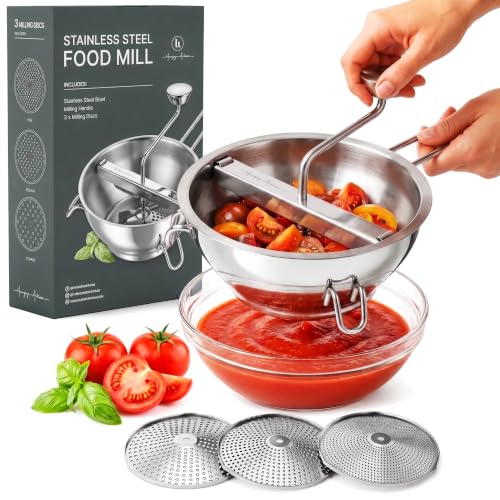
- Includes three texture discs
- Requires no electrical outlet
- Stainless steel construction
Best For: Adjustable tomato sauces and multi-purpose purees
Best Small-Batch Press
Weston 3-Cup Fruit & Tomato Press
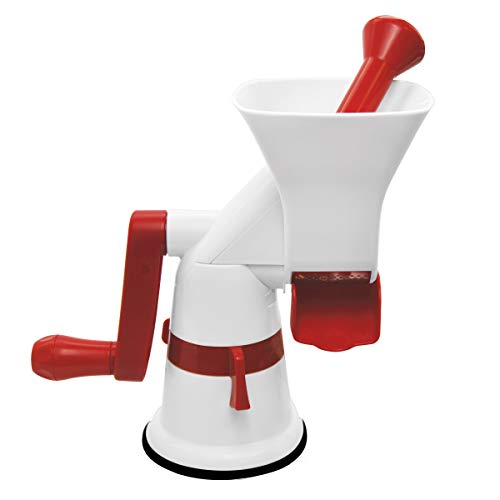
- 3-cup capacity suits small batches
- Stainless steel 2mm screen
- Auger helps limit jams and leaks
Best For: Small amounts of sauce, juice, and jam
Best High-Capacity Manual Press
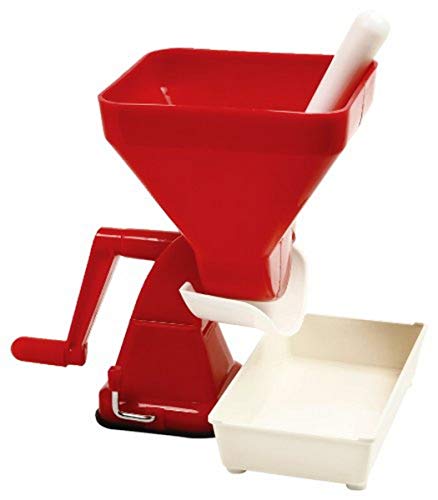
- 2.25-quart hopper for larger batches
- Stainless steel mesh strainer
- Suction base and receiving tray included
Best For: Canning prep and larger home batches
Compact Stainless Steel Mill

- Three discs for varied textures and seed removal
- Dual hooks help stabilize the mill over a bowl
- Dishwasher-safe with hanging storage
Best For: Small kitchens needing a versatile manual tomato mill
Easy-Mount Manual Press

- Processes produce without pre-peeling or deseeding
- Suction-cup base helps anchor the press
- Dishwasher-safe care with stainless steel blade
Best For: Small kitchens making occasional sauces manually
High-Output Electric Press
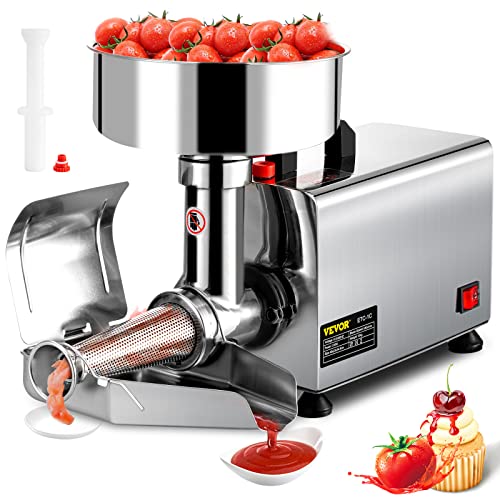
- 370W motor for powered sauce milling
- 304 stainless steel food-contact components
- 9-inch funnel and adjustable discharge trough
Best For: Larger batches where speed matters more than compact storage
Best All-Around Pick

- Includes five specialized screens
- Clamp fits 3/4- to 2-1/8-inch counters
- Supports sauces, purees, salsa, and more
Best For: Versatile cooks processing tomatoes and other produce
Best Compact Manual Option

- Quiet, motor-free operation
- Stainless steel filter separates skins and seeds
- Large feed inlet reduces frequent refilling
Best For: Small kitchens processing tomatoes and citrus
Best for Simple Cleanup

- Easy-to-clean simple structure
- Stainless steel filter separates peel and seeds
- Large feed inlet supports batch processing
Best For: Cooks wanting straightforward manual juicing
Best Compact Suction-Mount Pick – Easy Tomato Strainer
For small kitchens, this tomato press combines a relatively compact 9-by-6-by-8-inch footprint with a suction base that helps keep it steady while you strain, juice, or puree tomatoes. It separates skins and seeds to the side without requiring peeling, coring, or deseeding first.
Best For: Small-batch tomato juice, puree, salsa, and pasta sauce preparation.
Pros:
- Suction mount helps stabilize the food mill on smooth surfaces.
- Separates skins and seeds while the juice runs into the tray.
- Includes a stainless steel pusher and is designed for easy cleaning.
Cons:
- Plastic construction may be less substantial than an all-stainless-steel mill.
- Its 9-inch length and 8-inch height still require dedicated counter or storage space.
This is a practical choice when you want a straightforward manual tomato strainer for a small kitchen, especially if suction mounting and easy cleanup matter more than adjustable textures.
Best Adjustable-Texture Mill – Hungry Artisan 3-Disc Food Mill
This three-disc food mill is a versatile option among tomato presses for small kitchens, with a 15.5-by-8-by-3.5-inch profile and no need for an electrical outlet. Its interchangeable stainless steel discs let you choose coarse, medium, or fine results for sauces and purees.
Best For: Cooks who want adjustable tomato-sauce textures and one mill for multiple foods.
Pros:
- Three stainless steel discs provide coarse, medium, and fine textures.
- Manual crank works anywhere without an outlet.
- Stainless steel body, discs, and crank are suited to repeated use.
- Also handles applesauce, mashed potatoes, baby food, and jam bases.
Cons:
- Its 15.5-inch length may be challenging to store in a very compact kitchen.
- At 2.8 pounds, it is heavier than some smaller plastic options.
The Hungry Artisan stands out for flexibility: it is a strong fit if your small kitchen needs one manual tool for tomato sauce and several other pureeing tasks, rather than a tomato-only press.
Best Small-Batch Press – Weston 3-Cup Fruit & Tomato Press
The Weston Fruit & Tomato Press is designed specifically for smaller batches, with a 3-cup capacity that suits limited counter space and modest sauce-making jobs. Its manual handle turns an auger that separates skins and seeds from pulp, while the stainless steel screen uses 2mm holes.
Best For: Small batches of tomato sauce, juice, jam, or baby food.
Pros:
- Compact 3-cup capacity avoids the bulk of larger batch presses.
- Stainless steel screen helps separate seeds and skins from pulp.
- Auger is designed to help prevent jamming and leaking.
- Includes a stomper for guiding produce through the press.
Cons:
- The 3-cup capacity is limiting for large canning sessions.
- Manual winding requires hands-on effort for each batch.
For apartment kitchens or cooks who process produce in modest quantities, this Weston model offers a focused small-batch format without requiring power or a large appliance footprint.
Best High-Capacity Manual Press – Norpro Jumbo Tomato Strainer
The Norpro Jumbo Tomato Strainer offers a larger hopper and fitted receiving tray for cooks who want to process more produce by hand. Its suction base helps secure the press, while the stainless steel mesh separates seeds, skins, and stems for sauces, juice, puree, and paste.
Best For: Larger home batches and canning preparation when countertop space is available.
Pros:
- 2.25-quart hopper supports larger batches than a compact 3-cup press.
- Stainless steel mesh separates seeds, skins, and stems.
- Suction base helps keep the mill stable on smooth countertops.
- Includes a receiving tray, pestle, instructions, and starter recipes.
Cons:
- Its listed dimensions are substantially larger than other options for small kitchens.
- Manual operation still requires hand cranking.
- The larger hopper may be unnecessary for occasional, very small batches.
Although it is less space-conscious than the other choices, the Norpro is worth considering when “small kitchen” refers to manual equipment rather than tiny batch size. Its larger capacity can reduce the number of loading cycles during canning prep.
Compact Stainless Steel Mill – Multi-Disc Food Mill
For shoppers comparing tomato presses for small kitchens, this stainless steel food mill offers a compact, manual way to process tomatoes and other soft foods without an electric motor. Its three interchangeable discs, dual hooks, and hanging hole make it practical when counter and storage space are limited.
Best For: Small kitchens that need a versatile manual mill for tomato sauce, mashed potatoes, jams, fruits, and vegetables.
Pros:
- Stainless steel construction with a mirror-polished finish.
- Three milling discs provide different textures and can help remove seeds.
- Dual hooks and silicone-covered handle and crank support steadier grinding.
- Dishwasher-safe and designed for hanging storage.
Cons:
- Manual operation requires more effort than an electric press.
- At 1.29 kg, it is relatively substantial for a small hand tool.
This is the most space-conscious option for cooks who want one manual tool for tomato sauce and several other preparations. It is especially appealing if easy cleaning and multifunctionality matter more than high-volume processing.
Easy-Mount Manual Press – Suction-Cup Tomato Strainer
Among tomato presses for small kitchens, the Tonsa Tomato Strainer stands out for its manual design and suction-cup base. It is built to process tomatoes and other fruits or vegetables without requiring peeling, deseeding, or coring first.
Best For: Small kitchens wanting a manual tomato sauce, salsa, marinara, or applesauce maker with a temporary countertop mount.
Pros:
- Suction-cup base is designed to secure the press to a clean surface.
- Manual straining avoids the need to peel, deseed, or core ingredients beforehand.
- Stainless steel blade and dishwasher-safe care make cleanup more convenient.
- Handles tomatoes, fruits, and vegetables for sauces and related preparations.
Cons:
- Manual cranking is less suitable for large batches than an electric machine.
- The suction base requires a clean, suitable surface for secure attachment.
- Its listed capacity is 2.9 pounds, limiting the amount processed at once.
With a 20 x 17 x 31 cm listed product size and a removable manual setup, this press can suit cooks who want dedicated tomato straining without committing to a larger appliance. Its usefulness depends on having a countertop surface that holds the suction base securely.
High-Output Electric Press – 370W Tomato Milling Machine
For buyers considering tomato presses for small kitchens but expecting larger batches, this 110V electric strainer offers powered processing with a 370W pure copper motor. Its stainless steel food-contact parts, adjustable trough, and 9-inch funnel are designed for sauce making, though its 22-pound weight and commercial-grade format require dedicated space.
Best For: Home cooks or small food operations processing substantial quantities of tomatoes, ketchup, fruit sauces, or jams.
Pros:
- 370W motor supports powered milling instead of manual cranking.
- Food-contact components are made from 304 stainless steel.
- Large 9-inch funnel supports continuous feeding of fruit.
- Adjustable trough and trough brace help direct sauce and reduce splashing.
Cons:
- At 22 pounds and 19.3 x 9.1 x 13.6 inches, it is not especially compact.
- It requires a 110V AC power source and dedicated counter or storage space.
- Its higher output may be excessive for occasional small batches.
This machine prioritizes speed and capacity over the compact footprint usually associated with small-kitchen equipment. Choose it when batch volume justifies the larger appliance; otherwise, a manual press will be easier to store.
Best All-Around Pick – Johnny Apple Sauce Maker
For shoppers comparing tomato presses for small kitchens, the Johnny Apple Sauce Maker is a versatile countertop option with multiple screens for sauces, purees, salsa, and more. Its clamp fits surfaces from 3/4 to 2-1/8 inches thick, helping provide a secure setup without requiring a large appliance footprint.
Best For: Cooks who want one hand-crank strainer for tomatoes, fruits, vegetables, purees, and specialty sauces.
Pros:
- Includes apple/tomato, berry, pumpkin, salsa, and standard screens.
- Separates skins and seeds for smooth sauces and purees.
- Sturdy cast aluminum body with stainless steel screens.
- Backed by a 5-year warranty and compatible with an optional motor.
Cons:
- At 14.25 inches long and 5.1 pounds, it may need dedicated storage.
- The optional electric motor is sold separately.
- Requires a compatible countertop edge for its clamp.
This is the most adaptable choice of the group, especially if your small kitchen tool needs extend beyond tomato sauce. The included screens add flexibility, while the clamp-based design keeps installation straightforward.
Best Compact Manual Option – Hand Crank Tomato Strainer
Tomato Strainer, Hand Crank Tomato Press Grinder Tomato Sauce Maker Machine Food Mill
Check Price On AmazonThis hand-crank tomato strainer is a practical fit for small kitchens that favor simple, quiet tools. It uses a stainless steel filter to separate tomato skins, seeds, and pulp, while its manual operation avoids the need for an electric motor.
Best For: Home cooks and gardeners seeking a straightforward manual press for tomato juice, sauce, and occasional citrus or vegetable processing.
Pros:
- Stainless steel filter supports tomato, lemon, and orange juicing.
- Separates skins, seeds, and pulp from the juice.
- Manual design is nearly silent and energy-saving.
- Large feed inlet supports continuous processing with less refilling.
Cons:
- Manual cranking requires more hands-on effort than an electric model.
- Its PP shell may feel less substantial than a metal-bodied press.
- The bracket must be installed on a work surface.
Choose this model when quiet operation and a simple structure matter more than maximum versatility. It is focused on everyday juicing and sauce preparation without adding a motor to your countertop.
Best for Simple Cleanup – Manual Tomato Juicer
Manual Tomato Juicer Tomato Press Sauce Maker Food Strainer for Fruits and Vegetables Kitchen Tool
Check Price On AmazonWhen choosing tomato presses for small kitchens, this manual tomato juicer emphasizes uncomplicated operation and maintenance. Its stainless steel filter separates peel and seeds from pulp, while the large feed inlet is designed for processing batches with fewer interruptions.
Best For: Cooks who prioritize easy cleaning, efficient extraction, and a durable manual tool for fruits and vegetables.
Pros:
- High-hardness stainless steel filter supports efficient juicing.
- Separates peel and seeds for smoother juice.
- Simple structure is designed for convenient cleaning.
- Large feed inlet allows more continuous processing.
Cons:
- Manual operation requires ongoing cranking.
- The supplied notes do not list included screens for different textures.
- Its PP shell may be less robust than a cast-aluminum design.
This model makes sense for shoppers who want a focused, easy-to-maintain press rather than a multi-screen system. Its feature set centers on straightforward fruit and vegetable juicing with minimal complexity.
How We Picked the Best Tomato Presses for Small Kitchens
We focused on practical fit rather than maximum output alone. The selection includes manual tomato presses, rotary food mills, clamp-based models, suction-base designs, and one electric machine for shoppers who process larger quantities. We considered footprint, mounting or storage needs, construction materials, included screens or discs, expected batch size, cleanup demands, and versatility for foods such as applesauce, salsa, jams, and purées.
Because product specifications can vary by seller, confirm dimensions, included accessories, voltage, and replacement-part availability before ordering. A compact design is useful only if it can be securely supported and cleaned without frustration.
Quick Comparison
| Best for | Look for | Likely format |
|---|---|---|
| Occasional sauce | Simple setup and small footprint | Handheld strainer or food mill |
| Countertop convenience | Stable base or suction cups | Manual tomato press |
| Multiple textures | Interchangeable screens or discs | Three-disc food mill |
| Large harvests | Motor power and high throughput | Electric tomato strainer |
Key Buying Factors for Tomato Presses for Small Kitchens
Footprint and Storage
Measure the available counter and cabinet space before choosing. Clamp-style presses need a compatible table edge, while suction models need a smooth, clean surface. Removable parts are easier to store in a drawer or container than a tall, assembled machine.
Manual Effort and Capacity
Manual presses are quiet, affordable, and often adequate for a few jars, but crank resistance increases with tougher produce and larger batches. If you process tomatoes by the crate, an electric model may save substantial time, though it needs more storage and a nearby outlet.
Screen, Disc, and Material Quality
Fine screens produce smoother sauce, while coarser options can preserve more texture. Stainless steel components generally resist staining and odors, but check whether screens, augers, and seals are removable. Replacement parts can matter more than a low initial price.
Cleanup and Stability
Look for straightforward disassembly, accessible food-contact surfaces, and a firm base or dependable clamp. A press that shifts during use or traps pulp in hard-to-reach areas may be less practical than a simpler model.
Who Should Buy Which Tomato Presses for Small Kitchens?
Choose a compact handheld strainer or small food mill if you make sauce occasionally and prioritize easy storage. A three-disc mill is the better all-purpose choice when you also prepare applesauce, mashed vegetables, jams, or fruit purées. Pick a clamp-based press when your counter has a secure edge and you want hands-free stability. A suction-base model suits smooth countertops and quick setup, but verify that the cups hold firmly.
For gardeners, frequent canners, or families processing large harvests, the electric tomato strainer is the most time-saving option. It is less compact and may be louder, so it makes sense only when throughput outweighs storage convenience. Whichever style you choose, confirm the listed capacity and accessories, then select the model that fits your normal batch size—not the largest one available.