Making fresh tomato sauce is easier when a press separates skins and seeds while extracting the pulp. The right model can turn a large harvest into smooth sauce with less prep and cleanup.
We compare 10 tomato presses for home use, including compact manual tools, countertop electric machines, and higher-capacity options for serious preserving.
Best 10 Tomato Presses for Home Use Picks for 2026
Best Suction-Mount Starter

- Separates skins and seeds
- Suction base for stability
- Includes stainless steel pusher
Best For: Small-batch sauces, juice, puree, and salsa
Best Small-Batch Metal Press
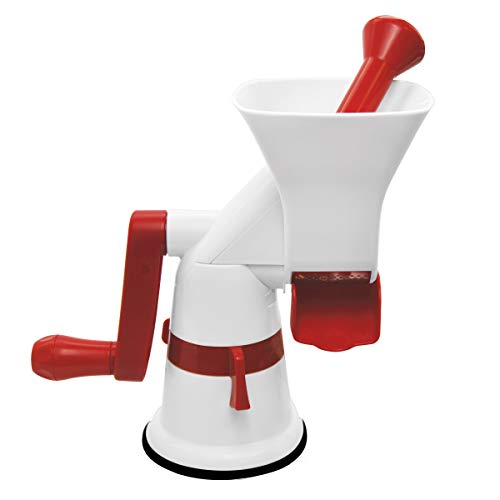
- 3-cup capacity
- Stainless steel 2mm screen
- Manual, jam- and sauce-ready design
Best For: Occasional small-batch preserving
Best High-Volume Electric Option

- Up to 330 pounds per hour
- 1/4 HP corded motor
- Metal housing and stainless hopper
Best For: Large tomato harvests with 220-volt power
Best Large Manual Hopper
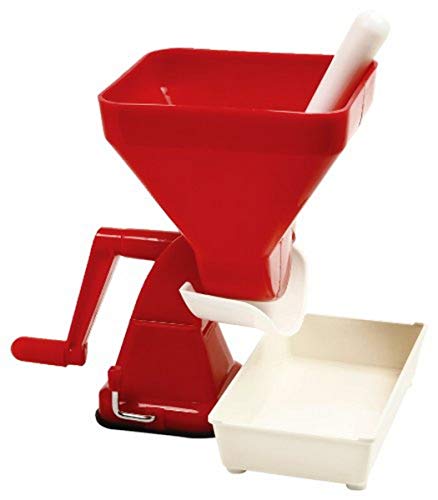
- 9-cup hopper for larger batches
- Stainless mesh separates skins and seeds
- Includes tray, pestle, and recipes
Best For: Frequent manual sauce making and canning prep
Best Manual Tomato Press
Weston Stainless Steel Tomato Strainer
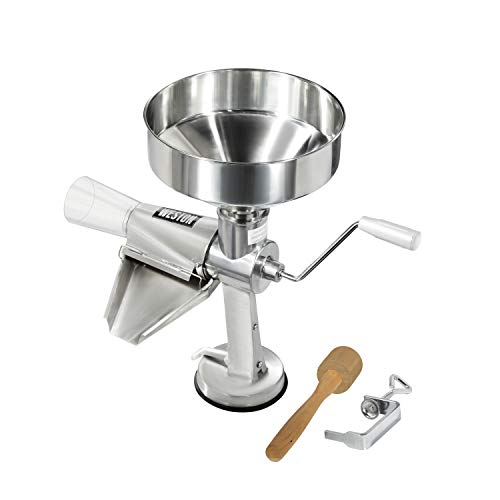
- One-gallon hopper for larger batches
- Dual suction-cup and C-clamp mounting
- Includes stomper and 1.5mm screen
Best For: Home canners who prefer manual control and flexible mounting
Best High-Capacity Tomato Press
Reber N.3 Electric Tomato Strainer

- 450-watt induction motor for continuous use
- Processes up to 309 pounds per hour
- Durable cast iron and stainless steel construction
Best For: Large-batch home preserving and serious garden harvests
Best Versatile Electric Tomato Press
Weston Deluxe Electric Strainer

- 250-watt motor with forward and reverse speeds
- One-gallon hopper for batch processing
- Three screens for different textures
Best For: Home cooks making sauces, purees, salsa, and preserves
Best All-Around Pick
VEVOR Electric Tomato Strainer

- Four screens support different sauce and puree textures
- 304 stainless steel parts resist fruit acids and wear
- Guard cover helps reduce splatter during continuous straining
Best For: Home preservationists making sauces, purees, salsa, and jams
Best for Large Batches
VBENLEM Commercial Tomato Strainer
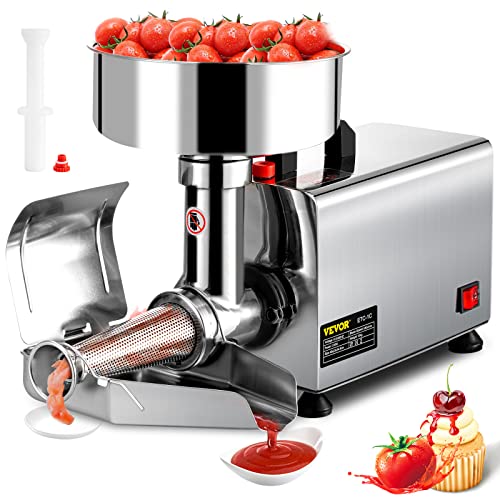
- 370W pure copper motor supports high-volume processing
- 9-inch funnel accommodates substantial fruit loads
- Adjustable trough helps direct sauce and reduce splashing
Best For: Experienced home canners processing large harvests
Best for High-Output Processing
Newhai Electric Tomato Strainer

- 450W motor and 8.4-inch funnel target fast processing
- Protected motor housing improves safety
- Works with tomatoes, berries, and other fruits
Best For: Home users processing large quantities of tomatoes and fruit
Best Suction-Mount Starter – Easy Tomato Strainer
If you want tomato presses for home use without peeling, coring, or deseeding first, this compact manual strainer is a practical choice. Its suction base helps hold it in place while you make juice, puree, salsa, or sauce.
Best For: Home cooks who want a straightforward manual press for small-batch tomato preparation and fresh salsa.
Pros:
- Separates skins and seeds while juice or puree exits through the tray.
- Suction mount helps stabilize the food mill during use.
- Includes a stainless steel pusher and is designed for easy cleaning.
Cons:
- Plastic construction may be less substantial than metal tomato presses.
- Supplied notes do not specify a batch capacity.
This is a useful entry-level option when convenience and a compact countertop setup matter more than high-volume processing.
Best Small-Batch Metal Press – Weston Fruit & Tomato Press
For shoppers comparing tomato presses for home use, the Weston offers a compact manual design with a 3-cup capacity. Turn the handle to separate seeds and skins from pulp for sauces, juices, jams, or baby food.
Best For: Home cooks making modest quantities of sauce, jam, juice, or pureed foods.
Pros:
- Stainless steel screen uses 2mm holes to strain the pulp.
- Innovative auger is designed to help reduce jamming and leaking.
- Includes a stomper and requires no electricity.
Cons:
- Its 3-cup capacity is suited to small batches rather than large harvests.
- Manual winding requires hands-on operation.
The Weston is a sensible middle ground for occasional preserving, especially if you prefer stainless steel components and a manageable countertop footprint.
Best High-Volume Electric Option – OMRA Spremy Electric Strainer
If your tomato presses for home use need to handle a substantial harvest, the OMRA Spremy adds powered processing. Its 1/4 HP motor automatically separates seeds and skins from fresh or cooked tomatoes, with production listed at up to 330 pounds per hour.
Best For: Home preservers processing very large quantities of tomatoes who have access to a 220-volt outlet.
Pros:
- Electric operation reduces manual cranking.
- Designed to process up to 330 pounds of tomatoes per hour.
- Features a die-cast metal housing, stainless steel hopper, and food-grade nylon auger.
Cons:
- Requires corded 220-volt power.
- Its high-volume design may be more machine than casual users need.
- Supplied notes do not mention a collection-tray size.
The OMRA stands out for serious seasonal processing, but confirm your electrical setup and available workspace before choosing it for home use.
Best Large Manual Hopper – Norpro Jumbo Tomato Strainer
The Norpro Jumbo is built for home cooks who want tomato presses for home use with more manual capacity. Its stainless steel mesh screen separates seeds, skins, and stems, while the suction base helps keep the press secure during cranking.
Best For: Home canners and gardeners making larger batches of tomato sauce, puree, juice, salsa, paste, or applesauce.
Pros:
- Large 2.25-quart, or 9-cup, hopper supports bigger batches.
- Includes a 5-cup receiving tray, pestle, instructions, and starter recipes.
- Suction base is designed to keep the mill stable on smooth surfaces.
- Stainless steel mesh automatically separates seeds, skins, and stems.
Cons:
- Manual cranking still requires hands-on effort.
- Its larger footprint may need substantial counter space.
- Suction mounting is intended for smooth countertops, tables, or islands.
With its generous hopper and included canning-prep accessories, the Norpro is a strong fit for frequent batch cooking without moving to an electric machine.
Best Manual Tomato Press – Weston Stainless Steel Tomato Strainer
For home cooks who want tomato presses for home use without relying on electricity, the Weston Metal Tomato Strainer offers a sturdy manual setup for sauces, purees, jams, and salsa. Its one-gallon hopper is suited to larger batches, while the included screen separates skins and seeds without requiring peeling or coring first.
Best For: Home canners who prefer a manual tomato press with flexible mounting and a large hopper.
Pros:
- Stainless steel hopper, chute, splash guard, and handle.
- One-gallon hopper helps process larger batches.
- Dual suction-cup and C-clamp mounting supports use on various flat surfaces.
- Includes a stomper and 1.5mm multipurpose screen.
Cons:
- Manual operation requires turning the handle.
- Additional screens are sold separately.
This is a practical choice for gardeners and preservers who value simple operation, adaptable mounting, and stainless steel construction. It is especially appealing when portability and hands-on control matter more than electric speed.
Best High-Capacity Tomato Press – Reber N.3 Electric Tomato Strainer
Among tomato presses for home use, the Reber N.3 stands out for cooks processing substantial quantities. Its 450-watt induction motor is designed for continuous operation and can process up to 309 pounds of tomatoes per hour, making it suitable for sauce, preserves, jams, and fruit juices.
Best For: Serious home preservers who need continuous electric processing for large tomato harvests.
Pros:
- 450-watt induction motor supports continuous operation.
- Rated to process up to 309 pounds of tomatoes per hour.
- Stainless steel AISI 304 filter cone, hopper, drip tray, and splash guard.
- Optional attachments expand its use beyond tomato straining.
Cons:
- At 21 pounds, it is heavier than many home-use presses.
- Optional accessories are needed for functions such as grinding or grating.
- Hand-wash care may require more cleanup time.
The Reber is built for users who regularly work through large batches and want a durable, Italian-made machine. Its capacity and continuous motor make it more appropriate for intensive preserving than occasional small servings.
Best Versatile Electric Tomato Press – Weston Deluxe Electric Strainer
The Weston Deluxe is a convenient option for tomato presses for home use when you want electric assistance and multiple texture choices. Its 250-watt motor, one-gallon hopper, reverse function, and three stainless steel screens support sauces, purees, jellies, salsa, and preserved garden produce.
Best For: Home cooks who want an electric press with multiple screens for smooth or chunky results.
Pros:
- 250-watt motor offers forward and reverse speeds.
- One-gallon hopper accommodates larger batches.
- Includes 1.5mm, 3mm, and 6mm stainless steel screens.
- Removes skins and separates seeds without coring.
Cons:
- Requires access to a 120-volt AC power source.
- Its 14-by-12-by-17-inch footprint may need dedicated counter space.
With its screen selection and reverse mode, this Weston offers useful flexibility for everyday preserving. It is a strong middle-ground choice for households that want faster electric processing without moving to a higher-capacity commercial-style machine.
Best All-Around Pick – VEVOR Electric Tomato Strainer
For home cooks comparing tomato presses for home use, the VEVOR offers a practical mix of steady electric performance, multiple texture options, and stainless steel construction. Its included screens and splash-reducing cover make it well suited to sauce, puree, salsa, and seasonal canning projects.
Best For: Home preservationists who want one machine for sauces, purees, salsa, and jams.
Pros:
- Separates peels and seeds in a single pass for smoother sauce and puree.
- Includes four screens—1 mm, 1.5 mm, 3 mm, and 6 mm—for different textures and recipes.
- 304 stainless steel food-contact parts are designed for durability and can be removed without tools.
- Steady, low-noise motor operation and a guard cover support larger batches with less splatter.
Cons:
- At 7.2 pounds, it may be less convenient to move than a compact manual press.
- The 800W maximum rating and 300W rated power may require careful comparison with similarly specified machines.
The VEVOR is a versatile choice when flexibility matters more than the simplest setup. Four screens and easy component removal give it an advantage for households making several kinds of preserved foods.
Best for Large Batches – VBENLEM Commercial Tomato Strainer
Among tomato presses for home use, the VBENLEM stands out for shoppers planning substantial harvest-season batches. Its 370W pure copper motor, large 9-inch funnel, adjustable trough, and stated 90–160 kg/h processing range are geared toward high-volume sauce making.
Best For: Experienced home canners and small operations processing large quantities of tomatoes or fruit.
Pros:
- 370W pure copper motor is designed for powerful, steady processing.
- Large 9-inch funnel helps feed substantial amounts of fruit at once.
- Adjustable discharge trough and brace help direct sauce and reduce splashing.
- Food-contact parts use 304 stainless steel and the machine is designed for disassembly and cleaning.
Cons:
- At 22 pounds, it is considerably heavier than the VEVOR model.
- Its commercial-grade size and stated 100 kg capacity may be more machine than occasional users need.
- The unit requires a 110V AC power source.
This VBENLEM model makes the most sense when throughput and feeding capacity are priorities. Its heavier construction and larger funnel favor bulk processing rather than quick, occasional batches.
Best for High-Output Processing – Newhai Electric Tomato Strainer
The Newhai is a strong option for shoppers seeking tomato presses for home use with commercial-style output. Its 450W motor, 8.4-inch stainless steel funnel, protected motor housing, and stated capacity of up to 110 pounds per hour support efficient tomato and fruit processing.
Best For: Home users who want high output and also plan to process strawberries, blueberries, and other fruit.
Pros:
- 450W motor and large funnel are designed for efficient, high-volume work.
- Processes tomatoes, strawberries, blueberries, and other fruits for sauces and jams.
- Protected motor casing offers more safety than models with exposed motors.
- Removable parts rinse clean easily, while the included pestle helps feed tomatoes during operation.
Cons:
- Hand washing is required, and the motor must be kept out of the water.
- The commercial-style design may be excessive for users making only occasional small batches.
- Supplied notes do not specify multiple interchangeable screens for texture control.
Choose the Newhai if output and broad fruit-processing capability matter most. Its protected motor housing and straightforward disassembly add practical value, though the hand-wash care routine and heavy-duty format may not suit every kitchen.
How We Picked the Best Tomato Presses for Home Use
We focused on the features that matter when processing tomatoes at home: extraction method, capacity, motor power, construction, ease of cleaning, and the amount of sauce each machine can handle in a session. The lineup includes manual presses for occasional batches and electric models for gardeners, cooks, and home preservers who process larger harvests.
Because advertised capacity and output can vary by tomato variety, preparation, and operating conditions, treat performance figures as useful guidelines rather than guarantees. A machine’s design, stability, and cleanup requirements are just as important as its headline wattage.
Quick Comparison
| Best For | Recommended Type | What to Look For |
|---|---|---|
| Small, occasional batches | Manual press | Stable clamp or base, comfortable handle, easy disassembly |
| Regular family-size batches | Compact electric press | Reliable motor, stainless or durable food-contact components |
| Large harvests and preserving | High-output electric model | Large hopper, continuous operation, sturdy frame, replaceable parts |
Key Buying Factors for Tomato Presses for Home Use
Manual or Electric Operation
Manual presses cost less and are straightforward to use, making them a practical choice for occasional sauce or salsa. Electric models reduce hand effort and are better suited to processing multiple baskets of tomatoes, though they usually require more storage space and cleaning.
Capacity and Output
Check the hopper size and stated throughput against your typical harvest. A small hopper may require frequent refilling, while a commercial-style machine can be unnecessarily bulky for a few jars. Continuous-feed designs are helpful when working through large quantities.
Construction and Stability
Look for food-contact parts that resist corrosion and frames that stay steady during operation. Stainless steel components are generally durable, while plastic parts can reduce weight and cost. A secure clamp, wide base, or suction feet can make manual and electric presses easier to control.
Cleanup and Adjustability
Removable screens, augers, funnels, and splash guards simplify washing. Some models let you adjust pulp consistency or use different screens, which is useful if you make sauces, purées, jams, or baby food as well as tomato products.
Who Should Buy Which Tomato Presses for Home Use?
Choose a manual model if you make sauce only a few times a year, have limited counter space, or want the simplest setup. Choose a compact electric press if you preserve regularly and value faster, less tiring processing. For very large gardens or group preserving, a high-output electric machine with a large hopper and durable metal components is the better fit.
Before buying, confirm the machine’s voltage, included accessories, replacement-part availability, and cleaning instructions. Matching the press to your batch size is the best way to avoid paying for excess capacity—or struggling with a machine that is too small.