Fresh tomatoes can produce exceptional sauce, but peeling, coring, and removing seeds by hand takes time. The best tomato presses streamline that work by separating skins and seeds while pushing usable pulp into your pot or bowl.
This roundup compares 10 manual and electric models, from compact home sauce makers to higher-capacity stainless steel machines. Consider power, throughput, cleanup, and the type of batches you normally prepare before choosing.
Best 10 Tomato Presses Picks for 2026
Italian Electric Performance

- Processes up to 330 lb. per hour
- Separates puree from skins and seeds
- Metal housing with stainless hopper
Best For: Large-batch tomato processing with a 220-volt outlet
Versatile Manual Processing
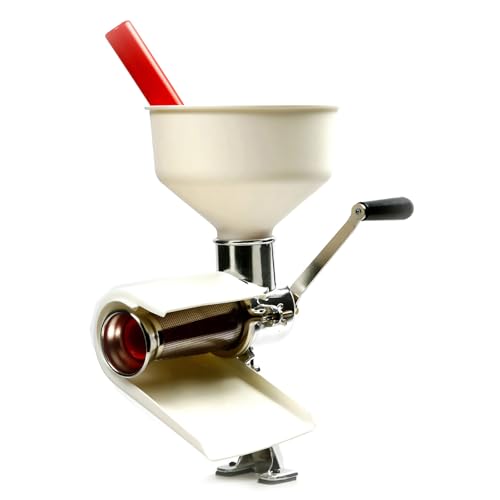
- Three-quart processing capacity
- Includes fine mesh screen and spiral
- Optional screens expand its uses
Best For: Multi-purpose fruit, vegetable, and sauce preparation
Simple Suction-Mount Straining
Compact Tomato Strainer Food Mill

- No peeling, deseeding, or coring required
- Suction-cup base helps hold it steady
- Includes stainless steel pusher
Best For: Small-batch homemade sauce and salsa
Heavy-Duty Italian Processing

- Processes up to 309 lb. per hour
- Continuous 450-watt induction motor
- Cast iron and stainless steel construction
Best For: Large-batch preserving and continuous tomato processing
Best Stainless Steel Option
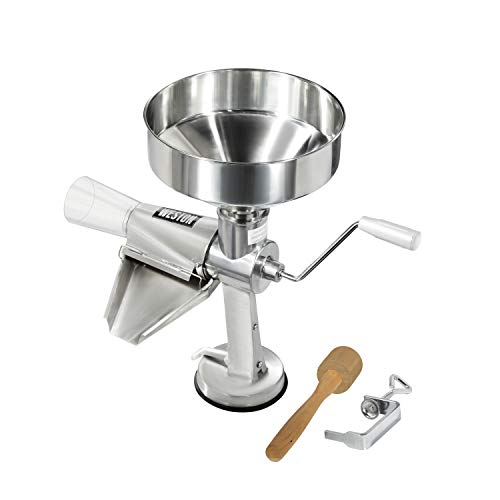
- One-gallon hopper for larger batches
- Dual suction-cup and C-clamp mounting
- Includes 1.5mm screen and stomper
Best For: Home canners processing larger batches
Best Jumbo Manual Press
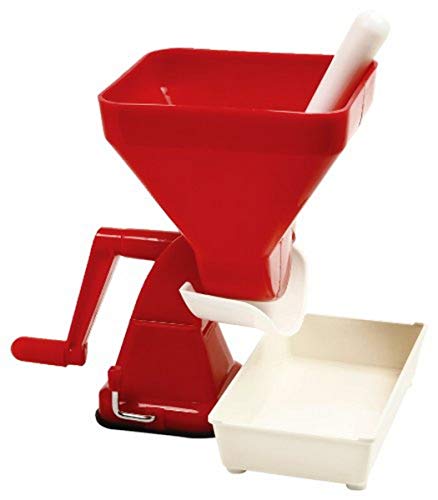
- 2.25-quart hopper for large batches
- Stainless mesh removes skins and seeds
- Includes tray, pestle, instructions, and recipes
Best For: Large-batch manual canning and applesauce
Best High-Volume Electric Model
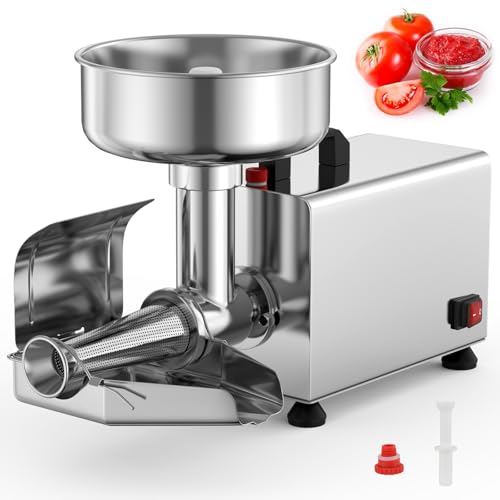
- 450W motor with 8.5-inch feed chute
- Designed for high-volume fruit processing
- Tool-free disassembly with dishwasher-safe parts
Best For: Large quantities and reduced manual effort
Versatile Batch Press
VEVOR Electric Tomato Strainer

- Separates skins and seeds in one pass
- Four screens for varied textures
- 304 stainless steel parts and splatter cover
Best For: Home canners making sauces, purees, salsa, and jam
Garden Harvest Favorite
Weston Deluxe Electric Tomato Strainer

- Two-speed 250W motor with reverse
- One-gallon hopper for larger batches
- Three stainless steel screens included
Best For: Home canners processing garden harvests and bulk produce
Heavy-Duty Processing Pick
VBENLEM Commercial Tomato Strainer
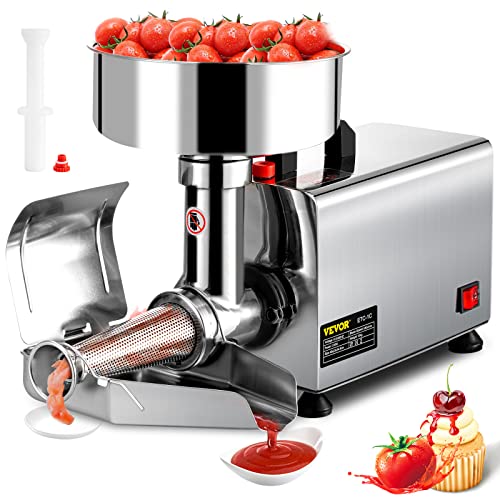
- 370W pure copper motor for high-volume use
- 304 stainless steel food-contact parts
- Large funnel and adjustable discharge trough
Best For: High-volume sauce, ketchup, and jam processing
Italian Electric Performance – OMRA Spremy 850
For shoppers comparing tomato presses, the OMRA Spremy Electric Tomato Strainer 850 is a compact, high-output option for turning fresh or cooked tomatoes into puree while separating skins and seeds. Its 1/4 HP motor, stainless steel hopper, and masticating-style auger are designed for efficient processing at up to 330 pounds per hour.
Best For: Gardeners and home cooks processing large tomato batches who want an Italian-made electric strainer.
Pros:
- Processes up to 330 pounds of tomatoes per hour.
- Automatically separates puree from seeds and skins.
- Features a die-cast metal housing and stainless steel hopper.
- Food-grade nylon auger runs at 110 RPM in a masticating style.
Cons:
- Requires a corded 220-volt power source.
- Its electric design may be more machine than occasional users need.
The OMRA stands out when capacity and automated separation matter most. Verify that its 220-volt requirement suits your kitchen before buying.
Versatile Manual Processing – Norpro Sauce Master
The Norpro 1951 Sauce Master is a practical choice among tomato presses for cooks who also want to process fruits and vegetables. Its three-quart capacity, chrome-plated steel screen, and included fine mesh screen help separate juice and pulp for sauces, purees, soups, and baby food.
Best For: Home cooks seeking a versatile food strainer with included accessories and optional screens.
Pros:
- Holds up to 3 quarts or 95 ounces.
- Separates smooth juice from pulp in one operation.
- Includes a fine mesh screen, standard spiral, recipe booklet, and instructions.
- Additional berry, pumpkin, and salsa screens are available separately.
Cons:
- Hand wash only; it should not be placed in the dishwasher.
- Additional specialty screens cost extra.
Choose the Sauce Master if flexibility is more important than electric speed. Its included accessories make it ready for a range of homemade recipes, while the optional screens broaden its uses.
Simple Suction-Mount Straining – Compact Tomato Strainer Food Mill
This compact tomato strainer is one of the more straightforward tomato presses for homemade sauce, salsa, and purees. It ejects skins and seeds to the side while juice flows into the tray, and its suction-cup base is designed to keep the food mill steady during use.
Best For: Home gardeners and casual cooks wanting a compact manual strainer for fresh tomatoes.
Pros:
- Strains tomatoes without peeling, deseeding, or coring first.
- Suction-cup base helps secure the food mill.
- Includes a stainless steel pusher.
- Designed for straining, juicing, pureeing, and homemade salsa.
Cons:
- Plastic construction may be less substantial than metal alternatives.
- Manual operation is less suited to very large batches.
For occasional farm-to-table cooking, this food mill keeps preparation simple and avoids several prep steps. It is best suited to smaller batches where compact size and easy operation are priorities.
Heavy-Duty Italian Processing – Reber N.3 Electric Strainer
For demanding tomato presses, the Reber N.3 combines a 450-watt induction motor with continuous operation and a stated capacity of up to 309 pounds per hour. Its cast iron body, stainless steel components, and oil-bath gearbox make it suitable for large batches of tomato sauce and preserves, while optional attachments add versatility.
Best For: Serious home processors who need continuous-duty performance for large tomato batches.
Pros:
- Processes up to 309 pounds of tomatoes per hour.
- 450-watt induction motor supports continuous operation.
- Uses a cast iron body and stainless steel filter cone, hopper, and tray.
- Compatible with optional pasta press, meat grinder, grater, and mixer attachments.
Cons:
- At 21 pounds, it is considerably heavier than compact strainers.
- Hand wash only.
- Optional attachments add to the overall cost.
The Reber is built for capacity, durability, and repeated processing rather than casual countertop use. It is a strong fit for preserving season, especially if you value continuous operation and future attachment options.
Best Stainless Steel Option – Weston Metal Tomato Strainer
The Weston Metal Tomato Strainer is a practical choice among tomato presses for home cooks who want stainless steel construction and flexible mounting. Its one-gallon hopper supports larger batches, while the included 1.5mm screen handles tomatoes and apples without peeling or coring first.
Best For: Home canners processing substantial batches of tomatoes, apples, sauces, jams, or purees.
Pros:
- Stainless steel hopper, handle, splash guard, and chute.
- One-gallon hopper helps process larger batches efficiently.
- Dual suction-cup and C-clamp mounting works on various flat surfaces.
- Includes a stomper and 1.5mm multipurpose screen.
Cons:
- Additional screens require the separately sold 4-piece accessory kit.
- Manual operation requires continuous cranking.
The Weston stands out for durable stainless steel parts, secure mounting options, and less-prep processing. It is especially appealing if you want one tomato press that can move between a kitchen counter and other flat work surfaces.
Best Jumbo Manual Press – Norpro Jumbo Tomato Strainer
The Norpro Jumbo Tomato Strainer is one of the more capacious manual tomato presses for making sauce, juice, puree, paste, or applesauce. Its 2.25-quart hopper and fitted receiving tray are designed to keep batch processing moving while the stainless steel mesh separates skins, seeds, and stems.
Best For: Canning projects and cooks who want a large-capacity manual press for tomatoes or cooked apples.
Pros:
- Large 2.25-quart hopper supports sizable batches.
- Stainless steel mesh separates seeds, skins, and stems.
- Suction base helps secure the press to smooth countertops and tables.
- Includes a receiving tray, food pestle, instructions, and starter recipes.
Cons:
- Manual cranking is slower and more labor-intensive than an electric machine.
- The suction base is intended for smooth surfaces.
- Its larger footprint may need substantial counter or storage space.
Choose the Norpro when capacity and a complete manual canning setup matter more than compactness. The included tray and pestle add convenience, while the mesh strainer supports smooth sauces and purees without skins or seeds.
Best High-Volume Electric Model – COSTWAY 450W Tomato Strainer
The COSTWAY 450W Electric Tomato Strainer is built for high-volume processing rather than occasional small batches. This commercial-grade tomato press uses a full-copper motor, an 8.5-inch feed chute, and food-grade 304 stainless steel construction for tomatoes and several types of fruit.
Best For: Users who need electric processing capacity for large quantities of tomatoes, berries, pineapple, or preserves.
Pros:
- 450W motor and large feed chute are designed for high throughput.
- Food-grade 304 stainless steel construction provides a durable processing body.
- Tool-free disassembly and dishwasher-safe detachable parts simplify cleanup.
- Safety features include an enclosed motor guard, anti-slip feet, and insulated switch.
Cons:
- At 22 pounds, it is substantially heavier than the manual options.
- Requires a 110-120V electrical supply.
- The product-care instructions specify hand washing.
The COSTWAY is the strongest fit when speed and volume take priority over portability. Its electric motor and wide feed chute can reduce manual effort, while the safety and cleanup features make it more practical for repeated large-batch use.
Versatile Batch Press – VEVOR Electric Tomato Strainer
For shoppers comparing tomato presses, the VEVOR Electric Tomato Strainer stands out for its 800W maximum output, steady 300W rated power, and multiple screens for different textures. It separates peels and seeds in one pass and is designed for continuous sauce making and larger harvest batches.
Best For: Home canners who want multiple texture options for tomato sauce, puree, salsa, jam, and juice.
Pros:
- Separates pulp, peels, and seeds for smoother results.
- Includes 1mm, 1.5mm, 3mm, and 6mm screens.
- Uses 304 stainless steel food-contact parts and includes a cleaning brush.
- Guard cover helps reduce splatter during operation.
Cons:
- The product weighs 7.2 pounds, so it is not the lightest option for storage.
- Its listed 800W maximum differs from the 300W rated power, which may require careful comparison.
Overall, this VEVOR model is a flexible choice among tomato presses when screen variety and continuous processing matter more than having the simplest setup.
Garden Harvest Favorite – Weston Deluxe Electric Tomato Strainer
The Weston Deluxe is one of the more straightforward tomato presses for preserving garden produce. Its 250-watt, two-speed motor, one-gallon hopper, and included screens support sauces, purees, jellies, and salsa without requiring manual coring.
Best For: Home preservers processing large batches of tomatoes and other soft fruits or vegetables.
Pros:
- Quickly removes skins and separates seeds without coring.
- Reverse speed can help prevent jamming.
- One-gallon hopper accommodates larger batches.
- Includes 1.5mm, 3mm, and 6mm stainless steel screens plus a stomper.
Cons:
- The 250-watt motor is less powerful on paper than the higher-wattage alternatives listed here.
- Its construction combines plastic and stainless steel rather than being all stainless steel.
With its large hopper, reverse function, and practical screen selection, the Weston is a well-rounded option for regular home canning and bulk produce preparation.
Heavy-Duty Processing Pick – VBENLEM Commercial Tomato Strainer
Among tomato presses, the VBENLEM 110V Electric Tomato Strainer is aimed at heavier processing with a 370W pure copper motor, a large 9-inch funnel, and a stated capacity of up to 100 kg. Its stainless steel food-contact components are designed for repeated sauce and jam preparation.
Best For: High-volume users who need a larger commercial-style machine for sauces, ketchup, and fruit jams.
Pros:
- 370W pure copper motor supports high-volume milling.
- Food-contact parts are made from 304 stainless steel and are easy to disassemble.
- Large 9-inch funnel helps with feeding produce.
- Adjustable trough and brace help direct sauce and reduce splashing.
Cons:
- At 22 pounds, it is substantially heavier than the other listed models.
- The supplied details do not list interchangeable screens for different textures.
- Its commercial-grade size may be more machine than occasional users need.
The VBENLEM makes the most sense when throughput and sturdier construction are priorities, particularly for users processing substantial quantities rather than a few tomatoes at a time.
How We Picked These Tomato Presses
We selected models across the main categories shoppers encounter: hand-crank sauce makers, countertop electric presses, and commercial-style machines. We considered motor power, hopper size, stated processing capacity, construction materials, included screens or accessories, and how suitable each press is for occasional home use versus large preserving sessions.
Because manufacturer capacity figures can vary by tomato variety, moisture content, preparation, and feeding speed, treat pounds-per-hour claims as general indicators rather than guaranteed results. Ease of assembly and cleaning also matters: a powerful machine is less useful if setup discourages you from using it.
Quick Comparison
| Best For | What to Prioritize | Typical Choice |
|---|---|---|
| Occasional small batches | Compact size and simple cleanup | Manual press |
| Regular home canning | Balanced motor power and durable parts | Home electric model |
| Large harvests | High throughput, stable base, and metal components | Commercial-style electric press |
| Maximum control | Adjustable pulp consistency and interchangeable screens | Multi-purpose sauce maker |
Key Buying Factors for Tomato Presses
Manual Versus Electric Operation
Manual presses are affordable, quiet, and easy to store, making them practical for smaller batches. Electric units reduce physical effort and make more sense when processing garden harvests or preparing several jars at once.
Capacity and Motor Power
Look beyond wattage alone. Hopper size, feed design, auger efficiency, and the manufacturer’s realistic throughput all affect performance. A high-output machine may be unnecessary for a few pounds of tomatoes, while a compact unit can become frustrating during peak harvest.
Materials, Stability, and Cleanup
Stainless steel and sturdy metal components generally provide better durability than lightweight plastic, though they may cost more. Check whether the base clamps securely, whether removable parts are easy to rinse, and whether the screen can be cleared without extensive disassembly.
Screen Design and Sauce Texture
Screen size and design influence how much pulp is extracted and how smooth the finished sauce becomes. If you also process grapes, berries, or other soft produce, look for compatible screens and attachments rather than assuming every press is multi-purpose.
Who Should Buy Which Tomato Presses?
Choose a manual model if you make sauce only occasionally, want the lowest upfront cost, or prefer a machine with no motor to store. Choose a compact electric press for routine family-sized batches where convenience matters more than maximum speed.
For gardeners and serious canners processing large quantities, prioritize a commercial-grade electric model with a stable base, durable metal food-contact parts, and clear replacement-part availability. If your recipes vary, a press with adjustable settings or additional screens can offer more flexibility. Whichever model you choose, cut oversized tomatoes into manageable pieces, follow the manufacturer’s feeding instructions, and clean the screen promptly after use.